Your Guide to International Freight: Key Terms You Need to Know

Relevant Articles

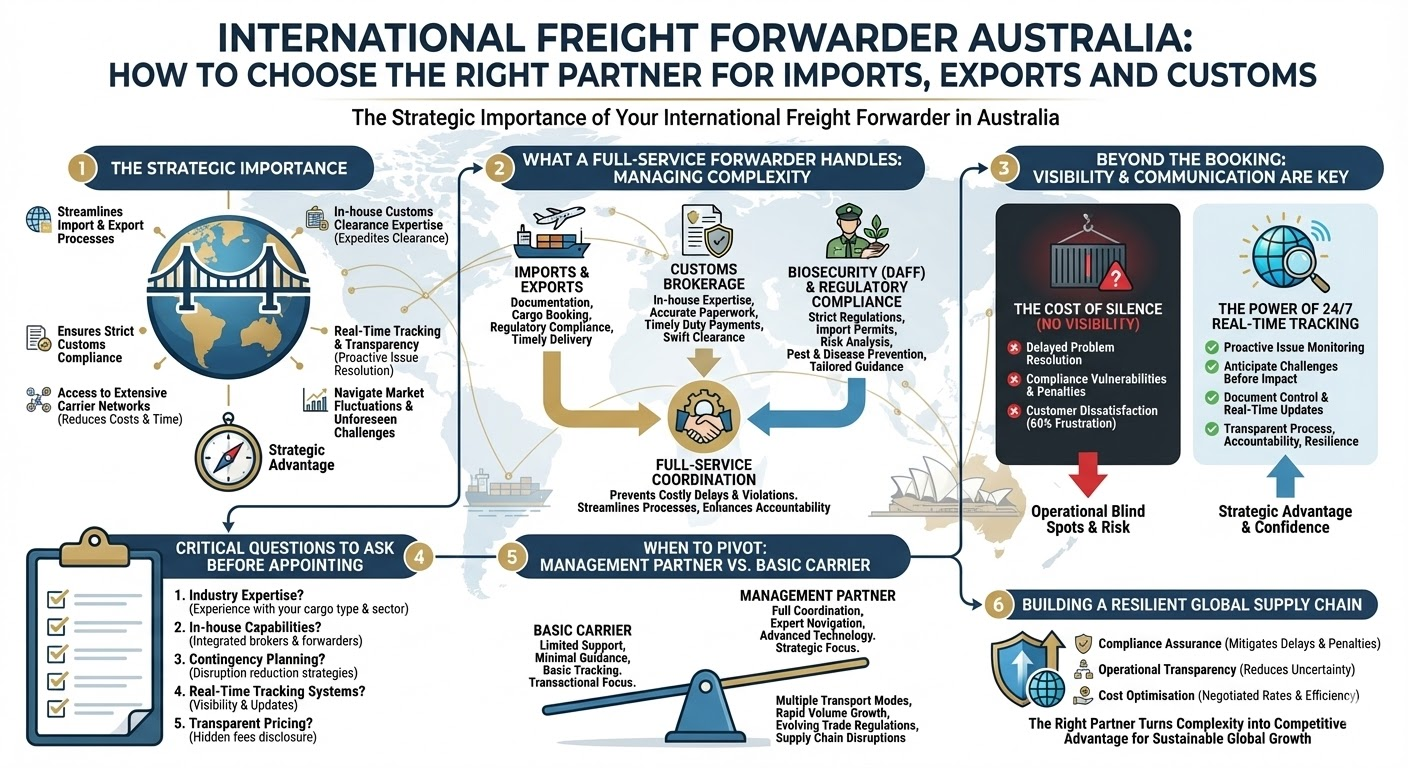
Understanding the language of international freight is essential for any business moving goods across borders. From managing documentation to navigating global transport networks, the industry has a language of its own. At Clique Logistics, we believe confident, informed decision-making starts with understanding the basics. Here’s a rundown of the key concepts you’ll encounter in international freight forwarding.

Freight Forwarders

A freight forwarder is a third-party agent that organises the movement of goods across international borders on behalf of importers and exporters.

Freight Forwarding

The overall process of planning and executing the shipment of goods globally, including booking, compliance, and delivery.

International Freight

A general term for the movement of goods between countries using various modes of transport and involving customs processes.

International Logistics

The complete coordination of product movement and information across international supply chains.

International Transport

The actual physical movement of goods between countries, often involving multiple modes such as sea, air, or land.

Customs Brokerage

The process of clearing goods through customs, including document submission, duty payment, and compliance.

Imports

Goods brought into a country from overseas, requiring knowledge of tariffs, compliance, and documentation.

Exports

Goods sent out of a country to another, with responsibilities including compliance with destination regulations.

Sea Freight / Ocean Freight

The most economical way to transport large volumes of goods globally, using FCL or LCL container shipping.

Air Freight

A fast but costlier option for moving time-sensitive, high-value, or perishable goods internationally.

4PL (Fourth-Party Logistics)

A comprehensive logistics partner that oversees the entire supply chain, including strategic management and integration of all logistics providers.

Global trade is full of moving parts, and understanding the terminology is the first step toward navigating it with confidence. These terms form the foundation of international freight and logistics.

At Clique Logistics, we empower our clients with the knowledge and tools they need to move freight across borders with confidence.

Ready to simplify your global freight? Reach out to the team at Clique Logistics and experience a smarter approach to international shipping.

Share This Post

Facebook
LinkedIn

More News

For thought-provoking insights and the latest company news.

Real-Time Tracking: Your Undeniable Competitive Edge in Today’s Market

In an era defined by relentless Market Changes and escalating stakeholder expectations, the ability for any business to operate with precision and agility is no longer a luxury—it’s a fundamental necessity. Traditional methods of tracking assets, managing supply chain operations, and understanding customer needs, often reliant on delayed information and periodic updates, are proving increasingly inadequate. Companies that cling to these outdated approaches risk falling behind, unable to adapt to the swift currents of the modern economy.

Read Article  

Australian Importers: Your Essential Customs Guide to International Freight

Navigating the intricate world of international freight to Australia can feel like charting an unknown sea for many Australian importers. The sheer volume of regulations, documentation requirements, and potential pitfalls can seem overwhelming. From understanding diverse trade agreements to ensuring strict biosecurity compliance, a misstep can lead to costly delays, unexpected fees, and significant disruption to your business operations.

Read Article  

The Race Against Time in Australia’s Freight Corridor

The wheels of commerce are constantly turning across Australia, with a vital artery pulsing between its three largest cities: Sydney, Melbourne, and Brisbane. In this dynamic corridor, the relentless race against time dictates the pace of business, impacting everything from consumer goods availability to industrial output. Traditional logistics, while foundational, often struggles to keep pace with modern demands, leading to costly delays and inefficiencies. However, a technological revolution is underway, powered by Artificial Intelligence and real-time data, promising to slash freight lead times and redefine the efficiency of Australia’s most critical trade route.

Read Article  
Scroll to Top

Error

The tracking number entered did not return any valid consignment. Please try again.

Freight Audit Guide

This field is for validation purposes and should be left unchanged.

contact us

This field is for validation purposes and should be left unchanged.
This field is hidden when viewing the form
Here is a radio button:
This field is hidden when viewing the form
Here is a checkbox: