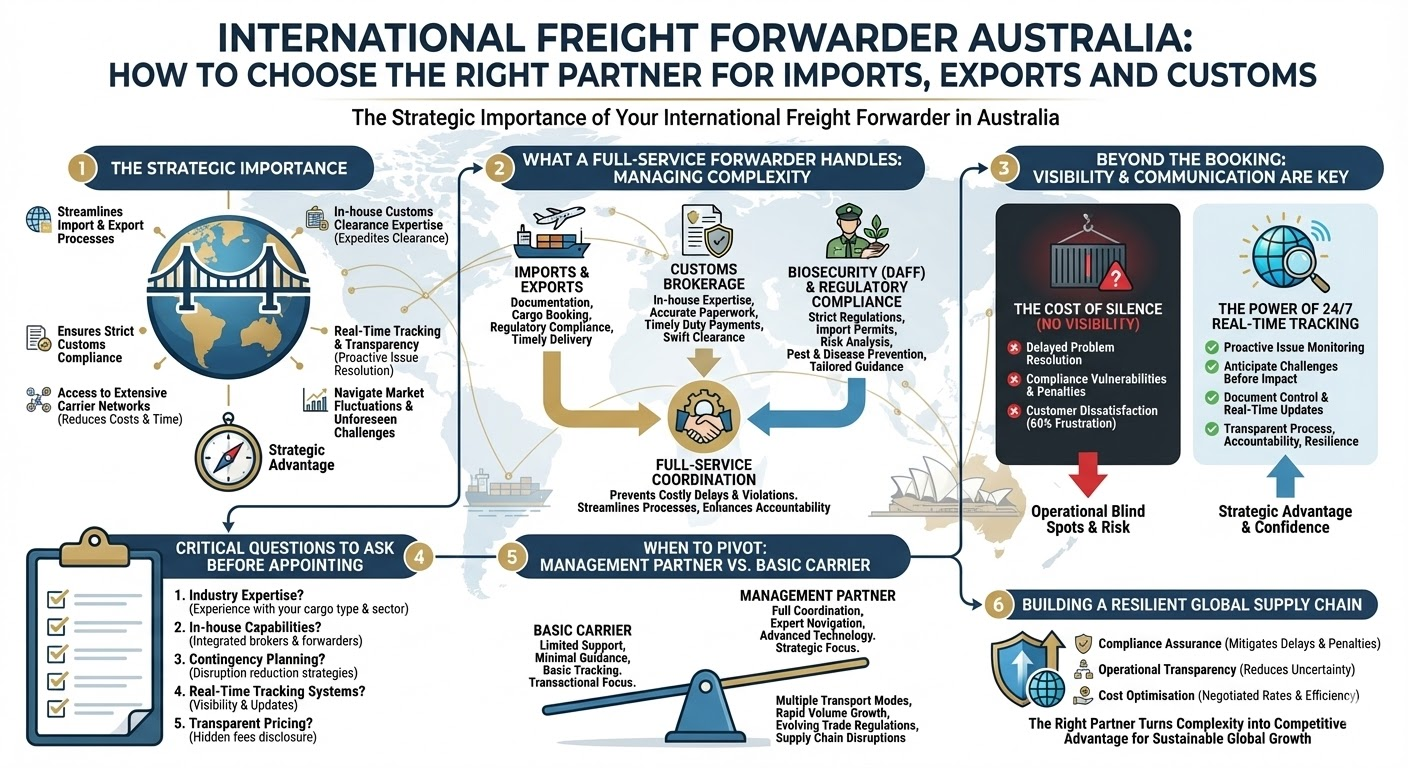
Selecting a competent international freight forwarder shapes the efficiency and compliance of your entire supply chain. In Australia’s regulated environment, the right partner streamlines import and export processes while ensuring adherence to strict customs requirements.
A proficient freight forwarder provides access to extensive carrier networks, reducing shipping costs and transit times. Their in-house customs clearance expertise manages complex documentation, expediting clearance and minimising supply chain delays.
Real-time tracking capabilities offer transparency and visibility, enabling businesses to address disruptions proactively. Furthermore, experienced forwarders utilise industry knowledge and contingency planning to navigate market fluctuations and unforeseen challenges.
What a Full-Service International Freight Forwarder Should Handle
A full-service international freight forwarder must manage the intricate interplay between imports, exports, and customs brokerage, orchestrating documentation and compliance across multiple jurisdictions simultaneously.
In Australia specifically, this responsibility extends to manoeuvring biosecurity regulations administered by the Department of Agriculture, Fisheries and Forestry (DAFF), alongside state-based import and export requirements.
This multifaceted coordination prevents costly delays and regulatory violations that can disrupt supply chains and damage business operations.
Managing the Complexity of Imports, Exports, and Customs Brokerage
International shipping involves multiple interconnected processes that demand specialised expertise and coordination. A thorough freight forwarder manages imports and exports seamlessly, handling documentation, cargo booking, and regulatory compliance. In-house customs brokerage services prove vital, ensuring accurate paperwork and timely duty payments without delays.
| Process | Responsibility | Outcome |
| Documentation | Prepare export/import papers | Regulatory compliance |
| Customs Clearance | In-house brokerage expertise | Swift clearance |
| Cargo Coordination | Book space, arrange transport | Timely delivery |
| Compliance | Monitor Australian regulations | Risk mitigation |
A reliable customs broker eliminates complications by consolidating these functions under one partner. This integration prevents finger-pointing between providers and reduces shipment delays. Businesses benefit from streamlined processes, transparent communication, and accountability throughout the entire international logistics journey.
Navigating Biosecurity (DAFF) and Regulatory Compliance
Beyond customs documentation and cargo coordination lies a critical layer of regulatory oversight that separates competent freight forwarders from industry leaders: biosecurity compliance.
Australia’s Department of Agriculture, Fisheries and Forestry (DAFF) enforces strict import and export regulations to protect the nation’s biodiversity and agricultural interests.
A full-service international freight forwarder must employ in-house customs brokers who understand these complex requirements. They should accurately complete Import Permits and Biosecurity Import Risk Analysis assessments, preventing pest and disease introduction.
Effective forwarders provide specific guidance on biosecurity measures tailored to cargo types—whether food, plants, or animals—ensuring compliance and avoiding costly penalties.
Comprehensive tracking systems keep stakeholders informed about regulatory issues throughout transit, demonstrating the accountability crucial for seamless international trade.
Beyond the Booking: Why Communication and Accountability Are the Real KPIs
Many businesses assume that once a shipment is booked, the heavy lifting is complete—yet the silence that follows often reveals the true quality of a freight forwarder.
When cargo moves across oceans and borders without clear visibility, delays compound, disruptions go unnoticed, and accountability evaporates.
Real-time tracking and proactive communication transform logistics from a black box into a transparent process where problems surface early enough to solve them.
The Cost of Silence: Why 24/7 Visibility is Non-Negotiable
What separates a logistics partnership that delivers results from one that merely processes shipments? The answer lies in 24/7 visibility and real-time tracking capabilities.
The cost of silence in supply chains is steep. When businesses lack continuous monitoring, operational blind spots emerge. Consider three critical consequences:
- Delayed problem resolution: Without real-time tracking, issues remain hidden until they escalate into costly complications.
- Compliance vulnerabilities: Customs delays go undetected without constant visibility, exposing shipments to penalties and regulatory complications.
- Customer dissatisfaction: Sixty per cent of businesses cite lack of real-time updates as a major frustration point in logistics management.
Forward-thinking forwarders eliminate these gaps through proactive visibility systems.
This transparency transforms logistics from a reactive function into a strategic advantage, enabling businesses to anticipate challenges before they impact delivery timelines or margins.
The Technology Stack: Document Control and Real-Time Shipment Tracking
In international freight forwarding, the difference between a smooth delivery and costly delays often hinges on two critical technological functions: robust document control systems and real-time shipment tracking.
Effective document control systems guarantee that all shipping paperwork is accurately managed, reducing compliance risks and preventing regulatory delays. Advanced tracking systems utilising GPS and RFID technology provide precise updates on shipment progress, empowering businesses to monitor cargo location and status throughout transit.
When integrated, these systems streamline operations significantly. Cloud-based platforms promote secure access to shipping documents from anywhere, allowing freight forwarders and clients to collaborate seamlessly.
This integration fosters quicker response times to emerging issues and strengthens overall supply chain efficiency. Together, document control and real-time tracking create transparency, accountability, and operational resilience—essential components for reliable international logistics.
Critical Questions to Ask Before Appointing a Forwarder
Selecting a freight forwarder without proper due diligence can expose businesses to hidden fees, regulatory complications, and supply chain disruptions. To lessen these risks, businesses should pose critical questions before an appointment:
- Industry expertise: Ask whether the freight forwarder has specific experience with your cargo type, ensuring they understand specialised handling requirements and compliance standards relevant to your sector.
- In-house capabilities: Confirm whether customs brokers and forwarders offer integrated services, including in-house customs clearance, which streamlines processes and reduces regulatory delays.
- Contingency planning: Request details on their disruption reduction strategies, ensuring robust protocols exist for managing transit delays or unforeseen complications.
Additionally, inquire about real-time tracking systems and transparent pricing structures, including potential hidden fees.
These questions establish whether a freight forwarder aligns with operational needs and risk management expectations.
When to Pivot: Signs Your Business Needs a Management Partner, Not Just a Carrier
Once a business has identified the right questions to ask potential forwarders, the next consideration becomes whether a basic carrier service suffices or whether a dedicated management partner is needed.
Several indicators signal that upgrading to a logistics partner becomes crucial. Businesses experiencing shipment complexity across multiple transport modes require streamlined coordination and compliance expertise. Rapid volume growth demands dedicated support to prevent bottlenecks and maintain scalability. Evolving trade regulations necessitate knowledgeable guidance through regulatory changes.
| Challenge | Basic Carrier | Management Partner |
| Multiple transport modes | Limited support | Full coordination |
| Regulatory changes | Minimal guidance | Expert navigation |
| Real-time visibility | Basic tracking | Advanced technology |
Supply chain disruptions and visibility requirements further justify partnering with a thorough freight forwarder. A true logistics partner provides contingency planning, alternative solutions, and integrated technology—transforming reactive shipping into proactive supply chain management.
Conclusion: Building a Resilient Global Supply Chain with the Right Partner
The journey toward supply chain resilience culminates in partnering with a freight forwarder that transcends basic carrier services. A reliable freight forwarder becomes instrumental in manoeuvring through Australia’s complex regulatory environment while optimising operational efficiency.
Building a strong relationship with the right partner yields measurable advantages:
- Compliance assurance through expert navigation of Australian import and export regulations, mitigating delays and financial penalties.
- Operational transparency via real-time tracking and proactive communication, reducing supply chain uncertainty and enhancing decision-making capabilities.
- Cost optimisation through harnessed industry expertise, negotiated freight rates, and streamlined shipping routes that directly impact profitability.
Businesses investing in thorough logistics partnerships position themselves for sustainable growth.
The right freight forwarder transforms international trade from a source of complexity into a competitive advantage, enabling companies to scale confidently in global markets.
Frequently Asked Questions
What Are the Typical Costs and Fee Structures for International Freight Forwarding Services?
International freight forwarding costs typically comprise several components: ocean or air freight charges based on weight and volume, customs brokerage fees, documentation handling charges, and domestic transportation costs.
Pricing varies significantly depending on cargo type, destination, weight, and urgency. Transparent forwarders itemise each fee separately, enabling clients to understand exact costs.
Some providers bundle services into flat rates, while others charge per service. Obtaining multiple quotes guarantees competitive pricing and service comparison.
How Long Does Customs Clearance Usually Take for Imports Into Australia?
As the saying goes, “time is money” in logistics.
Australian customs clearance typically spans 24 to 48 hours for standard imports, though complexity extends timelines significantly.
Documentation accuracy, product classification, and regulatory requirements directly influence processing duration.
Partnering with experienced customs brokers who understand Australian regulations streamlines this phase, preventing costly delays and ensuring compliant, efficient clearance of shipments.
Can a Forwarder Handle Both Dangerous Goods and Temperature-Controlled Shipments?
A capable international freight forwarder manages both dangerous goods and temperature-controlled shipments through specialised expertise and infrastructure.
Dangerous goods require certified personnel, compliance with hazmat regulations, and proper documentation.
Temperature-controlled logistics demands refrigerated containers and climate monitoring systems.
Extensive forwarders maintain separate handling protocols for each commodity type, ensuring regulatory adherence and cargo integrity throughout transit.
What Happens if Cargo Is Damaged During Transit or Customs Processing?
When cargo sustains damage during transit or customs processing, reputable forwarders typically manage claims through extensive insurance coverage and liability protocols. They investigate incidents, document evidence, and file claims with insurers or carriers.
Clique Logistics International exemplifies this through dedicated account managers who oversee accountability and guarantee proper documentation. Transparent communication regarding damage assessment, timelines, and compensation processes helps clients navigate recovery efficiently while maintaining supply chain continuity.
Do Forwarders Offer Consolidation Services to Reduce Shipping Costs for Smaller Shipments?
As the saying goes, “many hands make light work.”
Yes, most international freight forwarders offer consolidation services, pooling smaller shipments into shared containers to distribute costs across multiple clients. This approach significantly reduces per-unit expenses for businesses with lower volumes.
Consolidation services prove particularly valuable for companies unable to fill entire containers, enabling cost-effective international shipping while maintaining reasonable transit timelines and service quality standards.
Conclusion
Choosing a freight forwarder resembles selecting a surgeon blindfolded—hope for the best, expect delays. The right partner transforms supply chain chaos into orchestrated efficiency, while the wrong one leaves shipments languishing in customs purgatory. Between real-time tracking dashboards and genuinely responsive account managers lies the difference between thriving logistics and expensive nightmares. Select wisely; your inventory depends on it.
Key Takeaways
- Verify in-house customs brokerage expertise to ensure seamless navigation of biosecurity regulations and accurate Import Permits completion.
- Assess real-time tracking capabilities and cloud-based document systems for transparent visibility throughout the entire shipping process.
- Evaluate carrier networks and multi-modal transport coordination to reduce costs, transit times, and operational bottlenecks.
- Confirm regulatory knowledge and proactive communication practices to stay informed of compliance changes and mitigate penalties.
- Review industry experience and compliance track record to ensure a reliable partnership for sustainable international trade growth.