Freight management is often confused with freight broking, carrier contracting, or basic logistics coordination.
While these concepts are related, they represent very different levels of responsibility, accountability, and strategic involvement in a business’s supply chain.
Understanding this distinction is critical for Australian businesses operating across multiple states, freight modes, and carrier networks.
This article explains what freight management is, how it works in practice, and how it differs from traditional freight brokers.
WHAT IS FREIGHT MANAGEMENT?
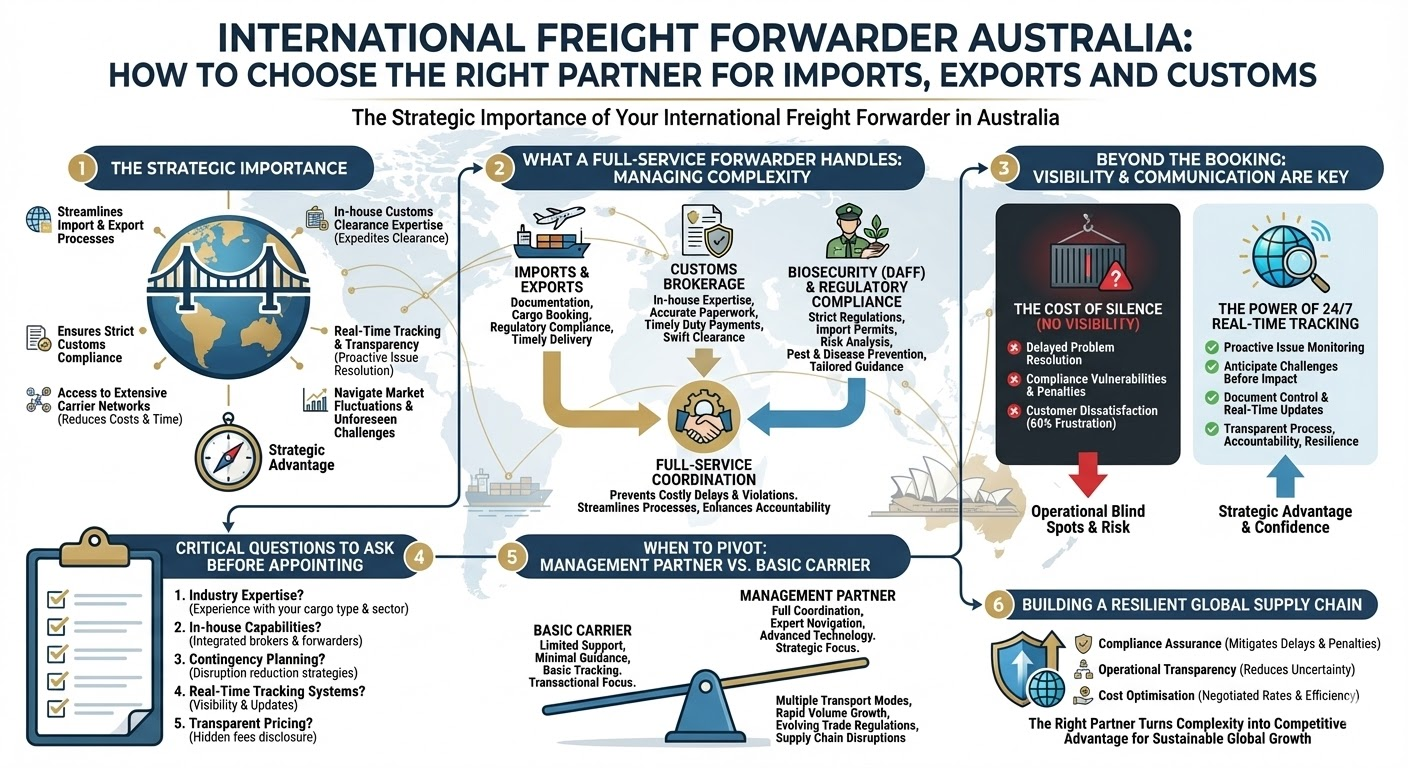
Freight management is the process of planning, coordinating, executing, monitoring, and continuously improving a company’s freight movements across carriers, regions, and transport modes.
Rather than focusing on individual shipments, freight management looks at freight as a system.
It aims to improve consistency, visibility, reliability, and cost control over time.
Freight management typically includes:
– Carrier selection and performance management
– Freight visibility and tracking
– Exception and issue management
– Cost control, auditing, and reporting
– Continuous optimisation of freight networks
In most cases, freight management is delivered by a third-party logistics provider (3PL) acting as a single point of accountability.
WHAT DOES A FREIGHT MANAGEMENT PROVIDER DO?
A freight management provider owns freight outcomes end-to-end.
This includes coordinating multiple carriers, monitoring performance, resolving issues, and reporting on results.
The focus is not simply moving freight, but ensuring freight moves reliably and predictably.
HOW FREIGHT MANAGEMENT WORKS IN PRACTICE
Businesses work with one partner. That partner manages multiple carriers behind the scenes. All freight moves through a single system. The business receives one point of contact and one set of reports.
This removes fragmentation and improves accountability.
WHAT IS A FREIGHT BROKER?
A freight broker typically facilitates transactional freight bookings.
Their role is to match a shipment with a carrier and arrange transport.
This can be effective for spot freight or irregular movements but does not usually involve long-term optimisation.
KEY DIFFERENCES BETWEEN FREIGHT MANAGEMENT AND FREIGHT BROKING
Freight management:
– Strategic and system-based
– Ongoing optimisation
– End-to-end accountability
Freight broking:
– Transactional
– Shipment-focused
– Limited accountability beyond booking
WHEN FREIGHT MANAGEMENT MAKES SENSE
Freight management is most valuable when:
– Freight volumes are consistent or growing
– Multiple carriers are used
– Shipments move nationally
– Internal teams are stretched
FREIGHT MANAGEMENT IN AUSTRALIA
Australia’s geography adds complexity:
– Long distances
– Metro and regional variability
– Limited redundancy on some lanes
Freight management provides structure and control in this environment.
FINAL THOUGHT
Freight management is not about booking freight faster.
It is about managing freight smarter, with accountability, visibility, and long-term improvement.