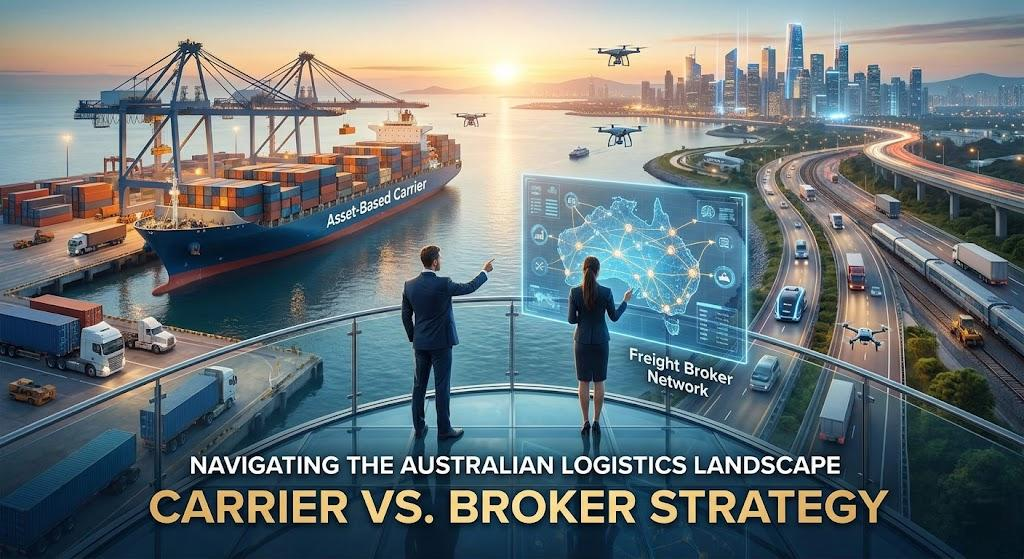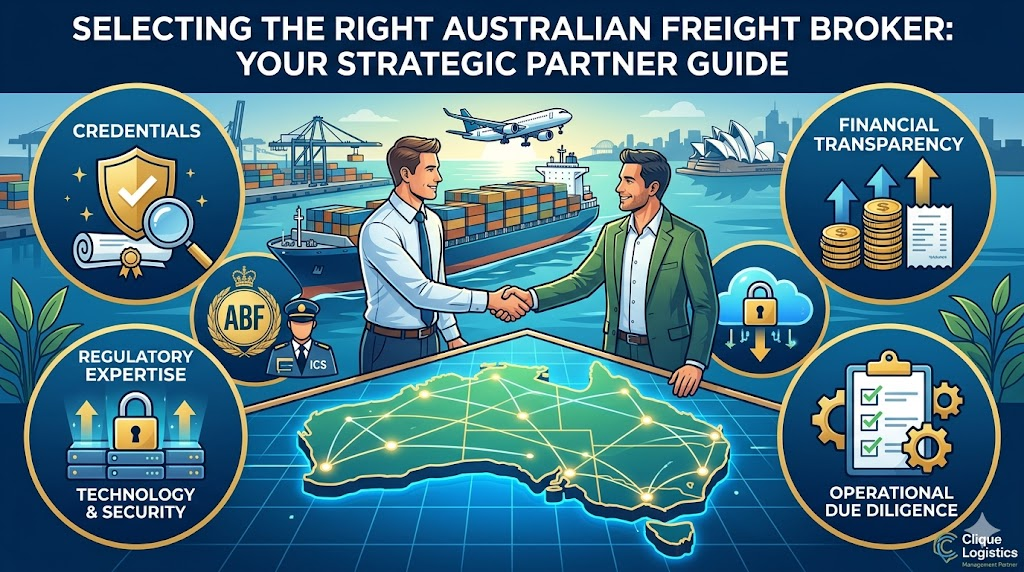
Navigating the Australian logistics landscape requires more than just finding a reliable way to move goods; it demands a strategic understanding of how your supply chain interacts with the broader economy. For many businesses, the choice between engaging a freight carrier or a freight broker represents one of the most significant operational decisions you will make. This guide provides an authoritative framework to help you evaluate these models, focusing on the realities of the Australian market, including regulatory compliance, technology integration, and total cost of ownership. By the end of this guide, you will have the knowledge to decide which model best supports your business growth, risk management, and long-term logistics strategy.
Understanding the Fundamentals: Asset Owners vs. Strategic Intermediaries
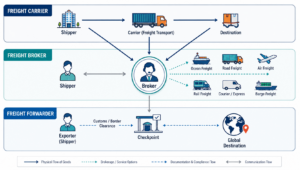
Visualising the supply chain flow: How shippers interact with asset-based carriers, asset-light brokers, and international forwarders.
The core of the freight industry is built on two distinct business models: the asset-based carrier and the asset-light freight broker. Understanding this divide is the first step in optimising your logistics spend.
What is a Freight Carrier? (The Asset-Based Model)
A freight carrier is a company that owns, operates, and maintains the physical assets required to transport goods. In the Australian market, these are the companies that possess the trucks, the shipping containers, the aircraft, or the warehouse infrastructure. When you contract directly with a carrier, you are forming a direct relationship with the entity that is physically handling your product. They operate on fixed schedules and designated routes, offering a high degree of control over the actual transport process.
What is a Freight Broker? (The Asset-Light Model)
A freight broker acts as the intermediary between the shipper (you) and the underlying carrier. They do not typically own the trucks or the ships. Instead, they leverage a vast network of connections to source capacity for your shipment. The broker’s value proposition is centred on agility, negotiation power, and the ability to source space even when market capacity is tight. They act as a single point of contact, handling the complexities of multiple shipments across various modes of transport.
The Third Player: Where do International Freight Forwarders Fit In?
International freight forwarders function as the architects of global logistics. While they may utilise brokerage models for local legs, their primary focus is on the international movement of goods. They manage the complexities of international freight, including customs clearance, quarantine, and the coordination of multiple transit modes across borders. For Australian businesses that import or export, a freight forwarder is often an essential partner, bridging the gap between overseas suppliers and domestic distribution networks.
The Operational Reality: How Each Model Handles Your Cargo
Operational efficiency in your supply chain is dictated by how you manage the flow of data and the physical movement of cargo.
The Carrier Experience: Direct Control and Standardised Routes
When dealing with a direct carrier, the process is linear. Your business interacts with one system, one set of billing protocols, and one operations team. This standardisation is excellent for high-volume, predictable freight where lanes are established and stable. However, the limitation of the carrier model is its rigidity. If your volume spikes, or if you need to access a region outside the carrier’s core network, you may face service limitations or increased costs.
The Broker Experience: Flexibility and the Power of a Logistics Network
The broker experience is defined by adaptability. Because brokers are not tied to a single fleet, they can pivot quickly. If a specific route becomes congested or a particular transport provider faces delays, the broker can shift your cargo to an alternative path. This network-based approach provides a buffer against market volatility, which is particularly useful for Australian businesses dealing with seasonal fluctuations in demand.
Technology Platforms: Freight Management Systems vs. Individual Carrier Portals
Technology integration is a significant differentiator. Carriers typically provide portals focused solely on their own fleet. In contrast, sophisticated freight brokers offer advanced management systems that aggregate data across multiple carriers. This allows for unified reporting, consolidated invoicing, and real-time visibility that is often superior to what a single carrier can provide, especially for businesses with complex supply chain requirements.
When to Go Direct: The Case for Partnering with Freight Carriers
Going direct to a carrier is not simply a cost-cutting exercise; it is a strategic choice for businesses that have reached a level of maturity where operational predictability is paramount.
High-Volume Stability and Dedicated Lanes
If your business ships the same volume over the same route consistently, a direct partnership is often the most cost-effective path. Carriers appreciate predictable volume, and they are often willing to offer preferential rates and prioritised service for dedicated lanes. This stability allows for tight integration between your inventory systems and their shipping schedules, minimising the “middleman” friction.
Specialised Requirements: Cold Chain and Dangerous Goods Handling
For businesses handling temperature-sensitive goods or dangerous materials, direct relationships are often safer. When you work directly with a carrier that specialises in cold chain logistics, you can audit their facilities, verify their equipment standards, and ensure that your quality control protocols are strictly followed at every stage of the transit.
Direct Carriers in the Australian Market: From Allied Express to Team Global Express
Australia’s geography presents unique challenges for carriers. Companies like Team Global Express or Allied Express have invested heavily in the infrastructure required to manage the “last mile” and regional distribution across the continent. When your business needs a deep, reliable network to move goods from major ports to remote interior locations, these large-scale, asset-based providers offer a level of reliability that smaller intermediaries might struggle to replicate.
The Strategic Advantage: Why Growing Businesses Choose Freight Brokers
For small-to-medium enterprises (SMEs) or rapidly growing companies, the agility provided by a freight broker is often a decisive competitive advantage.
Access to Negotiated Wholesale Rates and Reduced Freight Spend
Freight brokers aggregate the volume of all their clients to negotiate wholesale rates with large-scale carriers. As an individual business, you might not have the leverage to demand the best pricing, but by accessing a broker’s collective volume, you can often secure rates that would otherwise be unavailable to you. This is a primary driver of reduced logistics spend for many growing companies.
Scalability: Handling Seasonal Spikes without Administrative Overhead
Growth is rarely linear. When your business experiences a sudden spike in demand, a broker can scale your capacity instantly by tapping into their wider network. You do not need to onboard new carrier accounts or renegotiate contracts during a crisis. The broker handles the procurement of additional space, keeping your operations running smoothly despite the turbulence.
Real-Time Rate Comparison and Multimodal Transport Options
Brokers allow you to compare rates and service levels across multiple providers in real-time. Whether your priority is cost, speed, or a balance of both, a broker can present you with the best options for a specific shipment. They can also facilitate multimodal transport—using sea, air, and road in combination—to optimise your logistics strategy in ways that a single-mode carrier cannot.
The “Hidden” Costs: Evaluating Total Cost of Ownership (TCO)
When comparing brokers and carriers, many business owners focus solely on the “freight rate.” This is a mistake. The true cost of logistics must include the Total Cost of Ownership (TCO).
Administrative Overhead: Managing Multiple Invoices vs. Consolidated Reporting
If you use five different carriers, you must manage five sets of invoices, five reporting formats, and five different customer service channels. This creates a massive administrative burden. A broker simplifies this by providing a single point of billing and consolidated reporting, which can save your finance team dozens of hours of manual reconciliation work each month.
The Cost of Communication: Customer Service and Real-Time Updates
When a shipment goes missing or is delayed, who will resolve the issue? If you use a carrier directly, you are at the mercy of their support queue. A high-quality broker provides a layer of advocacy. Because you are their client, they have a vested interest in resolving the dispute with the carrier on your behalf, often providing faster resolution and proactive communication.
Technology Integration: Connecting eCommerce Platforms to Logistics Providers
Modern business is driven by data. If your shipping platform does not “talk” to your logistics provider, you are missing out on efficiency. Whether you are running Shopify, Magento, or a custom ERP, your system needs to push tracking data back to your customers automatically. Brokers are often more incentivised to provide custom API integrations that bridge these technical gaps compared to traditional, siloed carriers.
Navigating the Australian Regulatory Landscape
Compliance is the unseen anchor of the Australian logistics sector. Failure to meet requirements can lead to massive delays, fines, and even the seizure of goods.
The Compliance Shield: Customs Broking and Australian Border Force Requirements
International import and export is fraught with regulatory complexity. A skilled partner—whether an integrated freight forwarder or a broker with in-house customs expertise—is essential. They manage the entry process with the Australian Border Force, ensuring that your declarations are accurate and your tariff classifications are correct to avoid audits.
Biosecurity and DAFF: Managing Quarantine Clearance and Plant Exports
Australia maintains some of the world’s strictest biosecurity laws overseen by the Department of Agriculture, Fisheries and Forestry (DAFF). If your goods involve food, plant material, or organic matter, you need a partner who understands the intricacies of DAFF inspections. A professional customs broker acts as a barrier, ensuring that your documentation is perfect and that your cargo is prepared for inspection, preventing the costly delays associated with quarantine failures.
Australian Trusted Trader Status: Does Your Partner Help or Hinder?
The Australian Trusted Trader (ATT) program offers significant benefits to businesses that meet high standards of supply chain security and compliance. If you are aiming for or have already achieved ATT status, you need a logistics partner that aligns with these standards. Choosing a partner who is also an industry leader in compliance will reduce your administrative burden and improve your relationship with regulatory authorities.
Risk Management and Liability in the Supply Chain
Freight is inherently risky. Understanding your liability is the final piece of the logistics puzzle.
Understanding the Bill of Lading and Airway Bills
These documents are not just receipts; they are legal contracts of carriage. Understanding the nuances of a “House Bill of Lading” vs. a “Master Bill of Lading” can determine who is liable if your goods are damaged or lost at sea. Your chosen partner must provide clear documentation that defines the limits of their responsibility.
Insurance Coverage: Who is Responsible When Things Go Wrong?
Standard carrier terms often limit liability to a very low dollar amount per kilogram. If you are shipping high-value items, this will not cover your losses. You must evaluate the insurance coverage provided by your carrier or broker and, in most cases, arrange for comprehensive transit insurance. A broker can often help you secure better policy terms due to their volume of business.
Managing Exceptions: What Happens During Port Strikes or Interstate Transport Delays?
Exceptions are inevitable. Whether it is a strike at the Port of Melbourne or a road closure in the Outback, your logistics strategy must account for disruption. A broker’s strength lies in their contingency planning—knowing which alternate ports to use or which secondary carriers can step in when the primary lane is blocked.
Decision Matrix: Which Model Fits Your Business Growth Stage?
Choosing between a carrier and a broker is not a binary decision; it is a lifecycle decision.
- Startup Phase: Prioritise brokers. You need the flexibility, the lower upfront administrative costs, and the expert guidance to navigate customs without needing to build an internal logistics department.
- Scaling Phase: Maintain a hybrid approach. Use brokers for non-core or complex routes to keep your options open, while beginning to test direct contracts for your most frequent, high-volume shipping lanes.
- Established Enterprise: Transition toward a “Carrier-Heavy” model for your core routes to lock in service standards, but retain a small, high-performing group of brokers for speciality requirements, surge capacity, and cross-border complexity.
What’s Next?
You have now explored the fundamental differences between asset-based freight carriers and asset-light freight brokers, as well as the regulatory and operational nuances specific to the Australian market. By understanding the Total Cost of Ownership—including administrative overhead, compliance requirements, and risk management—you are equipped to move beyond simple rate comparison and build a resilient supply chain.
To implement these insights, follow these steps:
- Audit Your Current Spend: Categorise your shipping lanes by frequency and volume.
- Evaluate Compliance Gaps: Review your current customs and DAFF procedures. Are you relying on a partner who proactively flags issues, or are you catching mistakes after they happen?
- Assess Tech Integration: Review how your shipping data flows into your accounting and CRM systems. If manual data entry is a bottleneck, prioritise providers with robust API capabilities.
- Request a TCO Analysis: When interviewing new providers, don’t just ask for a rate card. Ask how their platform reduces your administrative load and what level of support they provide during unexpected delays.
- Start Small: Begin by shifting a single, high-volume lane or a complex international route to a new partner to test their operational responsiveness before committing your entire supply chain.
By taking a structured, evidence-based approach to your logistics partnerships, you will reduce your operational risk and position your business for more efficient growth. The Australian market rewards those who treat logistics as a strategic asset rather than a commodity expense. Act on this guide by auditing your processes today, and you will see the benefits in your bottom line for years to come.
For Australian businesses that need support beyond a single carrier relationship, Clique Logistics can help as a practical freight broker and freight management partner. Clique Logistics helps Australian businesses coordinate freight across multiple carriers and shipment types, including domestic freight, interstate freight, pallet freight, carton freight, road freight, air freight, and international freight requirements.
This makes Clique a suitable partner for SMEs, retailers, wholesalers, manufacturers, distributors, and eCommerce businesses that want better freight visibility, stronger carrier coordination, and a more structured approach to managing freight as their business grows.