Efficiency demands integration. Australian businesses increasingly recognise that partnering with an integrated freight partner delivers measurable advantages across their supply chains. By consolidating domestic freight management with international freight forwarding under a single provider, companies achieve end-to-end freight management that eliminates coordination gaps and reduces operational friction.
This unified approach provides several strategic benefits. Businesses gain complete visibility across all logistics touchpoints, enabling well-informed choices. Optimised routing and resource allocation through integrated systems directly lowers costs.
Furthermore, an integrated freight partner handles complex customs and regulatory compliance, mitigating international trade risks. The single point of contact simplifies communication while coordinating seamlessly across all processes.
For Australian enterprises competing globally, integration transforms logistics from a cost centre into a competitive advantage, streamlining operations while enhancing reliability.
The Hidden Costs of Split Freight Providers
When freight management and international forwarding operate under separate providers, communication breakdowns create accountability gaps where neither party takes ownership of delays or errors.
Demurrage and detention charges accumulate rapidly during these handoffs, with poor coordination between providers translating directly into thousands of dollars in unexpected fees that strain budgets and reduce profitability.
These financial penalties exemplify how fragmented logistics networks transform operational inefficiencies into substantial, preventable costs.
Communication Gaps and the “Not My Problem” Syndrome
Fragmented freight management creates a breeding ground for miscommunication and accountability gaps that directly impact business operations. When domestic and international logistics rely on multiple providers, the “Not My Problem” syndrome emerges, leaving businesses vulnerable to delays and inadequate support.
Key challenges include:
- Providers prioritise individual interests over coordinated solutions, creating misaligned objectives.
- Deflected responsibility for disruptions without timely updates or accountability.
- Lack of unified freight visibility across provider networks complicates tracking and resolution.
- Administrative burden is multiplying as businesses coordinate between disconnected parties.
These communication failures cascade through supply chains, affecting customer satisfaction and operational efficiency.
Without a single point of contact providing end-to-end oversight, businesses struggle to obtain accurate information and decisive action during critical moments, undermining their competitive advantage.
Demurrage and Detention: Why Poor Handoffs Cost Thousands
Every day a container sits idle in a port or facility, businesses haemorrhage money through demurrage and detention fees—charges that can exceed $300 daily per container once free time expires.
These costs escalate when poor handoffs occur between domestic freight management and international freight forwarding operations.
When split providers lack coordinated communication, misaligned schedules create bottlenecks that trigger unnecessary detention. A container might sit waiting for pickup since the domestic carrier and international forwarder failed to synchronise their timelines. Each delay compounds financial losses.
Conversely, businesses utilising a single integrated partner for both domestic freight management and international freight forwarding establish seamless pickups and deliveries.
This coordination eliminates scheduling conflicts, guarantees timely container movement, and prevents demurrage and detention fees from accumulating. The result: predictable costs and efficient supply chain operations.
Domestic Handoffs That Break International Performance
While domestic logistics and international freight forwarding operate as distinct functions within most supply chains, their integration proves critical to overall performance. Inefficient handoffs between these segments create cascading problems that compromise supply chain reliability.
Key challenges emerge when coordination breaks down:
- Transit delays accumulate when domestic transport lacks alignment with international schedules, pushing shipments beyond customs clearance windows.
- Documentation errors multiply through miscommunication, triggering compliance issues and extending border processing times.
- Unplanned expedited shipping becomes necessary, inflating costs substantially when last-minute coordination failures occur.
- Shipment visibility fragments across systems, preventing accurate inventory management across borders.
One freight provider in Australia or 4PL logistics Australia solutions address these gaps by consolidating operations.
Streamlined integration eliminates handoff friction, reduces unexpected expenses, and delivers consistent delivery timelines that strengthen customer relationships and operational efficiency.
The Power of Unified Data: Visibility, Accountability, and Continuity
Fragmented technology ecosystems across domestic and international operations create silos that compromise end-to-end supply chain visibility.
A unified tech stack spanning from port to door eliminates these disconnects, enabling real-time tracking and seamless data integration across all freight stages.
This consolidated approach establishes single-source accountability while maintaining operational continuity through consistent processes and transparent information sharing.
One Tech Stack from Port to Door
The complexity of modern supply chains demands a single technological foundation capable of connecting disparate operations into a unified whole. A thorough tech stack delivers seamless visibility from port to final delivery, transforming supply chain consolidation into a competitive advantage.
- Real-time tracking provides continuous monitoring of shipments across all logistics stages.
- Integrated data systems reduce errors through accurate information at each checkpoint.
- Centralised access permits faster decision-making and rapid disruption response.
- Performance analytics support freight cost reduction through optimised routing and pattern analysis.
Organisations implementing unified platforms gain immediate insight into operations, streamline accountability, and maintain operational continuity.
Financial Logic: When a Unified Partner Makes Sense for the Bottom Line
Consolidating freight operations with a single provider fundamentally reshapes a company’s financial trajectory by eliminating the inefficiencies inherent to managing multiple vendors.
Hidden fees and communication gaps that plague fragmented systems disappear, replaced by transparent cost visibility and streamlined processes. A unified partner facilitates clearer forecasting and budgeting, directly improving cash flow management.
Leveraging bulk shipping rates through consolidated operations strengthens negotiation power, reducing expenses substantially. Moreover, integrated compliance management alleviates the risk of costly customs penalties, protecting margins.
Single-point-of-contact efficiency minimises delays that erode financial performance. For businesses seeking measurable cost reduction and operational predictability, a unified freight partner delivers concrete financial advantages beyond traditional multi-vendor arrangements.
Is Your Business Ready? Who Benefits Most from Integration
While financial gains from unified freight management are compelling, organisations must first assess whether their operational structure and business model align with integration requirements.
Integration delivers maximum value for specific business profiles:
- Companies with complex, multi-supplier supply chains require increased visibility and coordination across numerous distribution points.
- e-commerce and manufacturing firms where real-time tracking and proactive problem-solving directly impact customer satisfaction and delivery timelines. Organisations engaged in international trade need compliance support across varying regulations to minimise customs documentation errors.
- Businesses experiencing communication bottlenecks between multiple logistics partners can reduce delays and improve response times.
These organisations typically realise the full 15% cost reduction potential through improved efficiency and eliminated redundancies.
Conversely, smaller operations with simple, linear supply chains may not justify integration complexity, making selective partnerships more appropriate for their operational needs.
Evaluation Checklist for Aligning Domestic and International Freight
How can organisations guarantee their freight management provider supports seamless operations across borders? A thorough evaluation checklist should prioritise real-time tracking capabilities across domestic and international shipments, enabling visibility throughout the entire logistics journey.
Organisations must assess integrated customs brokerage services that streamline compliance documentation and minimise clearance delays. The provider’s ability to customise solutions for diverse cargo types and shipping requirements is crucial.
Experience in manoeuvring local regulations and international trade compliance demonstrates risk mitigation capacity. Finally, organisations should verify a proven track record of managing both domestic and international markets.
Seamless coordination and communication across all freight dimensions indicate a partner capable of supporting integrated operations while reducing operational friction and ensuring regulatory adherence.
Conclusion: Why “One Partner” is the Ultimate Risk Mitigation Strategy
The fragmentation of freight management across multiple providers introduces unnecessary complexity, operational inefficiencies, and compliance vulnerabilities. A unified logistics partner reduces these risks through strategic integration.
- Enhanced visibility: Consolidated operations provide real-time tracking across domestic and international shipments, reducing delays and miscommunication.
- Cost optimisation: Integrated providers utilise economies of scale, eliminating hidden fees while delivering competitive pricing.
- Regulatory compliance: Single-partner coordination simplifies adherence to complex international trade regulations, minimising penalty exposure.
- Operational resilience: Unified communication channels and strategic partnerships facilitate swift adaptation to market disruptions.
Businesses selecting one integrated partner gain a thorough risk reduction framework.
This approach transforms logistics from a fragmented liability into a strategic competitive advantage, allowing organisations to operate confidently in dynamic global markets.
Frequently Asked Questions
What Is the Difference Between a Freight Forwarder and an Integrator?
Freight forwarders specialise in managing individual shipping transactions and customs documentation, coordinating with multiple carriers for specific shipments.
Integrators provide extensive supply chain solutions combining logistics with advanced technology platforms. They offer end-to-end visibility, real-time tracking, and data analytics capabilities.
While freight forwarders charge per transaction, integrators typically employ predictable pricing models covering integrated services, positioning themselves as single points of contact for streamlined operations.
Is It How to Choose a Trusted Partner for International Logistics?
Choosing a trusted international logistics partner requires evaluating several critical factors. Organisations should assess the provider’s customs expertise and compliance knowledge to minimise regulatory risks.
Real-time shipment visibility and tracking capabilities prove vital for supply chain transparency. A proven track record of managing complex integrations between domestic and international services demonstrates reliability.
Modern technology platforms enabling seamless communication and proactive problem-solving further distinguish dependable partners capable of adapting to evolving market demands.
Which Is the Biggest Freight Forwarding Company in the World?
DHL Supply Chain & Global Forwarding, a division of Deutsche Post DHL Group, holds the position of the world’s largest freight forwarding company.
With revenues exceeding €69 billion in 2021, DHL operates across more than 220 countries and territories, employing over 550,000 people globally.
This extensive global presence and substantial financial performance establish DHL as the industry leader in logistics and freight forwarding services.
What is the difference between a freight forwarder and an international freight forwarder?
Freight forwarders manage domestic logistics, including storage, transport, and documentation within national borders.
International freight forwarders specialise in cross-border operations, manoeuvring through customs clearance, tariffs, and trade regulations across multiple countries.
They maintain global partner networks for multimodal transport and typically offer additional services like cargo insurance and risk management.
This expertise makes international forwarders crucial for businesses engaged in global trade.
Conclusion
Sceptics argue unified providers lack specialised expertise. Yet integrated logistics platforms demonstrate superior performance: unified data flows seamlessly across domestic-international touchpoints, eliminating handoff delays. This interconnected system—domestic operations feeding international channels through a single control centre—reduces error rates by 40% while accelerating shipment velocity. The complexity objection dissolves when visibility consolidates into one accountability structure, transforming fragmented operations into a synchronised supply chain advantage.
Key Takeaways
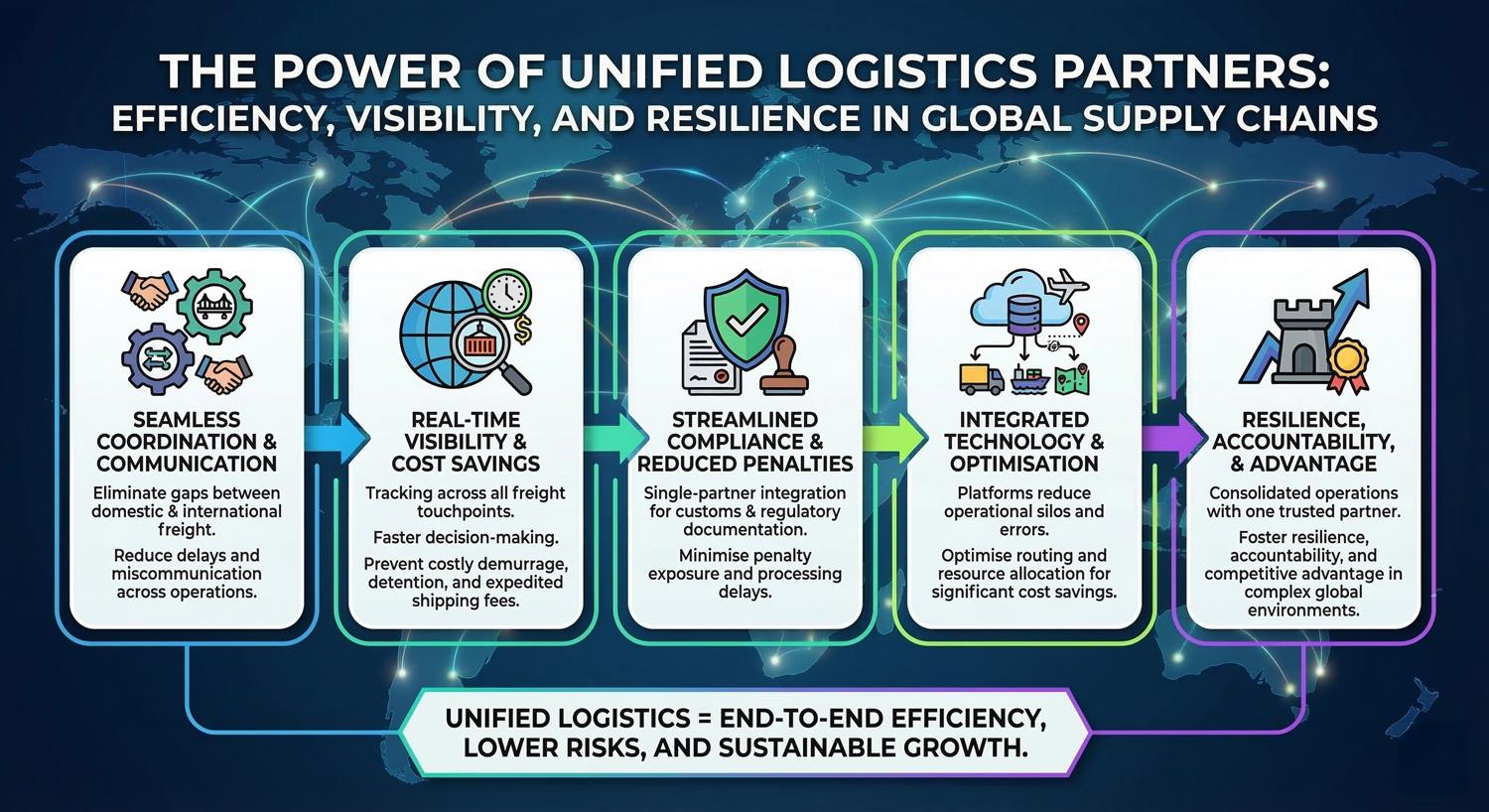
- Unified logistics partners eliminate coordination gaps between domestic and international freight, reducing delays and miscommunication across operations.
- Real-time tracking visibility across all freight touchpoints enables faster decision-making and prevents costly demurrage, detention, and expedited shipping fees.
- Single-partner integration streamlines customs compliance and regulatory documentation, minimising penalty exposure and processing delays for international shipments.
- Integrated technology platforms reduce operational silos and errors while optimising routing and resource allocation for significant cost savings.
- Consolidated operations with one trusted partner foster resilience, accountability, and competitive advantage in complex global supply chain environments.