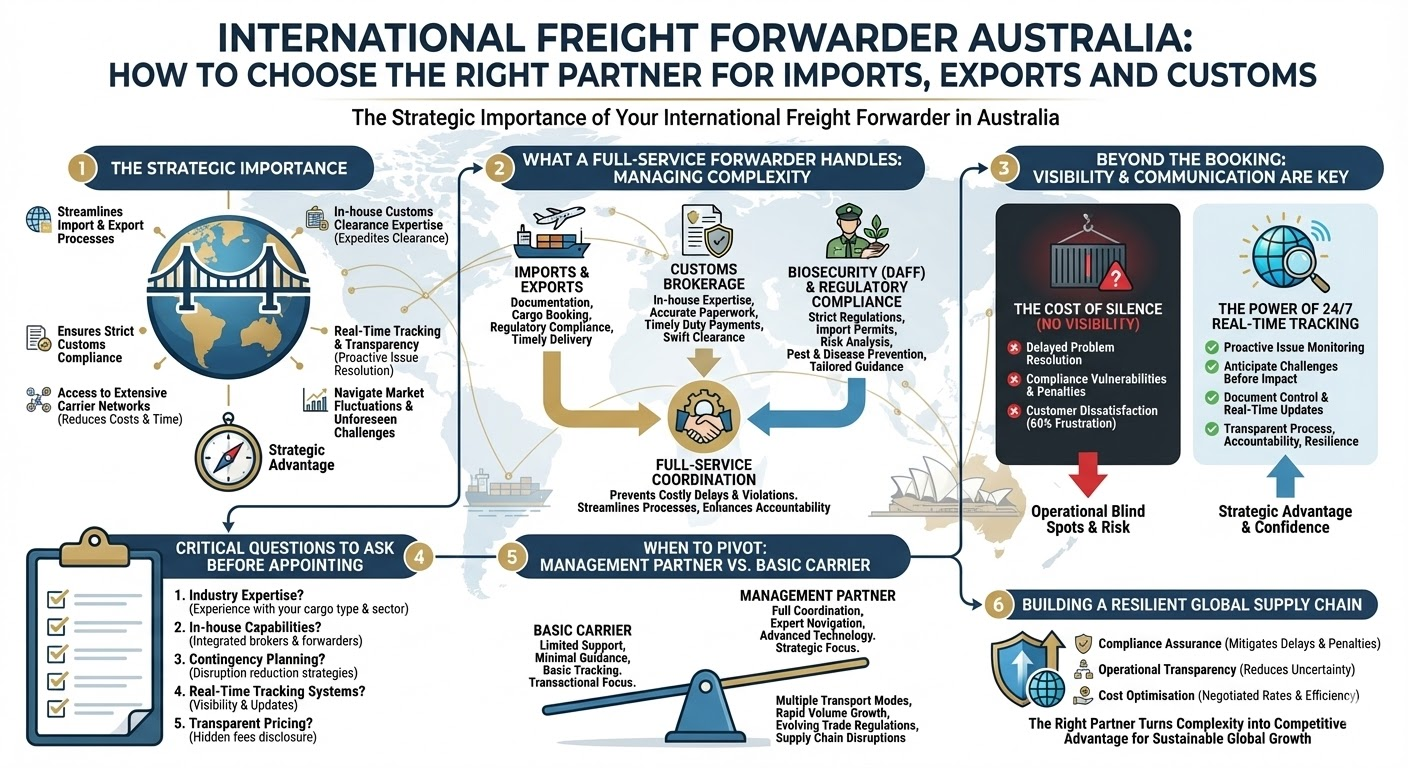
Choosing a freight management partner is a strategic decision, not a transactional one.
For Australian businesses, the right partner can improve service, reduce friction, and support growth.
The wrong choice can introduce risk, inconsistency, and hidden cost.
This article explains how to choose a freight management partner in Australia and what to look for beyond headline pricing.
WHAT A FREIGHT MANAGEMENT PARTNER ACTUALLY IS
A freight management partner is not simply a carrier or booking service.
They act as an extension of your operations team, coordinating carriers, managing performance, and owning freight outcomes.
Their role is to design, manage, and improve your freight system over time.
WHY THIS DECISION MATTERS
Freight touches customers, cash flow, and internal teams.
Poor freight performance damages customer experience and distracts staff.
A strong freight management partner reduces noise and creates consistency.
KEY CRITERIA FOR CHOOSING A FREIGHT MANAGEMENT PARTNER
1. CLEAR ACCOUNTABILITY
The partner should act as a single point of accountability.
You should not be chasing carriers, depots, or drivers.
One partner should own issues end-to-end.
2. CARRIER-AGNOSTIC APPROACH
A strong freight management partner is not locked to one carrier.
They should manage multiple carriers and select them based on performance, not preference.
3. AUSTRALIAN FREIGHT EXPERIENCE
Australia’s freight environment is unique.
Your partner should understand:
– Interstate freight complexity
– Metro vs regional challenges
– State-based carrier performance
Local experience matters.
4. VISIBILITY AND REPORTING
Freight management should provide:
– Shipment tracking across all carriers
– Centralised reporting
– Clear visibility of issues and trends
If visibility is fragmented, control is lost.
5. PROACTIVE ISSUE MANAGEMENT
Delays and issues are inevitable.
What matters is how early they are identified and how they are handled.
A freight management partner should be proactive, not reactive.
6. SCALABILITY
Your freight needs will change.
Your partner should be able to scale with:
– Volume growth
– New regions
– New service requirements
Changing partners frequently creates disruption.
QUESTIONS TO ASK POTENTIAL PARTNERS
– How do you manage multiple carriers?
– How is performance tracked and reviewed?
– What visibility will we have?
– How are issues escalated and resolved?
– How do you support businesses as they grow?
These questions reveal how the partner actually operates.
RED FLAGS TO WATCH FOR
– Over-reliance on one carrier
– Lack of reporting or transparency
– Purely price-driven conversations
– Limited understanding of your industry
These often indicate a transactional model.
FREIGHT MANAGEMENT VS PRICE COMPARISON
Choosing based on price alone ignores:
– Service reliability
– Internal workload reduction
– Customer experience impact
Freight management is about total outcome, not lowest rate.
FINAL THOUGHT
Choosing a freight management partner is about trust, capability, and alignment.
For Australian businesses, the right partner brings structure, visibility, and confidence to freight operations — allowing teams to focus on growth rather than logistics noise.