How International Freight Forwarding Works (And Where It Breaks)

Relevant Articles

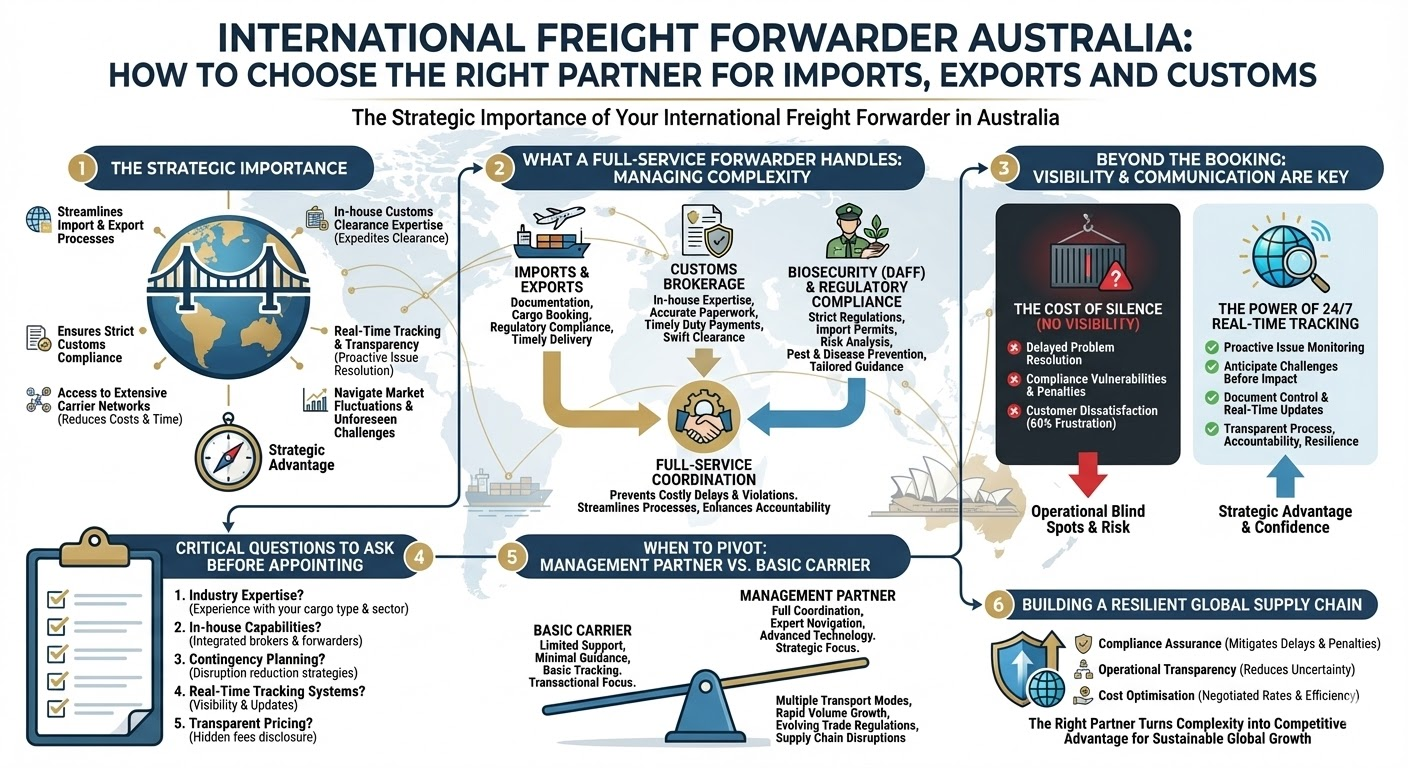
On paper, international freight forwarding looks straightforward. Goods move from a supplier to a port, onto a vessel or aircraft, through customs, and then into a domestic delivery network.

In reality, international freight forwarding is a series of handover points — and every handover is a potential failure point.

The process begins well before freight moves. Documentation accuracy, packaging standards, Incoterms and supplier readiness all determine how smoothly freight will flow. Many issues blamed on “shipping delays” actually originate at origin due to misalignment or missing information.

Once freight is in transit, control shifts between multiple parties: origin agents, shipping lines or airlines, port operators, customs brokers and domestic carriers. Without a clear coordinating party, issues can escalate quickly.

This is where international freight forwarding often breaks down. If no one owns the full journey, problems are addressed in isolation rather than resolved holistically. A delay at the port becomes a customs issue. A documentation error becomes a delivery failure.

Effective international freight forwarding in 2026 requires active coordination, not passive handover. A forwarder should be monitoring milestones, anticipating congestion risk and intervening early when something deviates from plan.

Customs clearance is another critical point. Clearance isn’t just about compliance — it’s about timing. Delays here can cascade into storage, delivery and customer commitment issues if not managed proactively.


Finally, the transition into the domestic network is where international freight often loses visibility. Best practice ensures international and domestic legs are aligned, with service levels and expectations clearly set.

International freight forwarding works best when one party owns the journey end-to-end — not just the booking.

Share This Post

Facebook
LinkedIn

More News

For thought-provoking insights and the latest company news.

HOW TO CHOOSE A FREIGHT MANAGEMENT PARTNER IN AUSTRALIA

The modern business landscape is characterised by a relentless pace, evolving consumer expectations, and a constant battle for competitive advantage. For Small and Medium-sized Enterprises (SMEs), navigating these complexities can be particularly challenging, especially when it comes to the final leg of delivery. Last-mile logistics, the critical but often costly process of getting products from a distribution hub to the end customer, has become a significant pain point. Escalating surcharges, driven by a confluence of factors, are increasingly squeezing SME profit margins, threatening their ability to compete. However, a strategic paradigm shift towards “elastic logistics” offers SMEs a powerful, often overlooked, weapon to combat these rising costs and thrive in a dynamic market. This article explores how adopting an elastic approach to logistics can transform delivery challenges into opportunities, providing SMEs with the agility and resilience needed to succeed.

Read Article  

WHEN SHOULD AUSTRALIAN BUSINESSES OUTSOURCE FREIGHT MANAGEMENT?

The modern business landscape is characterised by a relentless pace, evolving consumer expectations, and a constant battle for competitive advantage. For Small and Medium-sized Enterprises (SMEs), navigating these complexities can be particularly challenging, especially when it comes to the final leg of delivery. Last-mile logistics, the critical but often costly process of getting products from a distribution hub to the end customer, has become a significant pain point. Escalating surcharges, driven by a confluence of factors, are increasingly squeezing SME profit margins, threatening their ability to compete. However, a strategic paradigm shift towards “elastic logistics” offers SMEs a powerful, often overlooked, weapon to combat these rising costs and thrive in a dynamic market. This article explores how adopting an elastic approach to logistics can transform delivery challenges into opportunities, providing SMEs with the agility and resilience needed to succeed.

Read Article  
Scroll to Top

Error

The tracking number entered did not return any valid consignment. Please try again.

Freight Audit Guide

This field is for validation purposes and should be left unchanged.

contact us

This field is for validation purposes and should be left unchanged.
This field is hidden when viewing the form
Here is a radio button:
This field is hidden when viewing the form
Here is a checkbox: