Chain of Responsibility: Why Freight Risk Is an Operational Issue

Relevant Articles

Chain of Responsibility (CoR) is often treated as a legal or compliance obligation. In practice, it’s a direct reflection of how freight is planned, packaged and executed day to day.


Most CoR risk doesn’t come from deliberate non-compliance. It comes from poor alignment — unrealistic delivery windows, unclear despatch instructions, inappropriate vehicle selection or inconsistent carrier expectations.


Clique embeds Chain of Responsibility considerations into everyday freight management decisions. That means thinking beyond the booking and considering how freight will actually move through the network.


For example, service level mismatches can create pressure at depots and on drivers. Poor packaging can lead to unsafe loads. Inaccurate documentation increases handling risk. None of these issues are legal in nature — they’re operational.


By addressing them at the planning stage, risk reduces naturally.


This approach is particularly important for businesses operating nationally, where freight moves through different regulatory environments and infrastructure conditions. What works in a metro lane may not be appropriate for regional or remote movements.


CoR compliance becomes sustainable when it’s built into the freight setup rather than enforced after the fact. Clear expectations, realistic timeframes and appropriate carrier selection protect everyone in the chain.


Chain of Responsibility isn’t about restriction. It’s about control and accountability — and those are operational strengths.

Share This Post

Facebook
LinkedIn

More News

For thought-provoking insights and the latest company news.

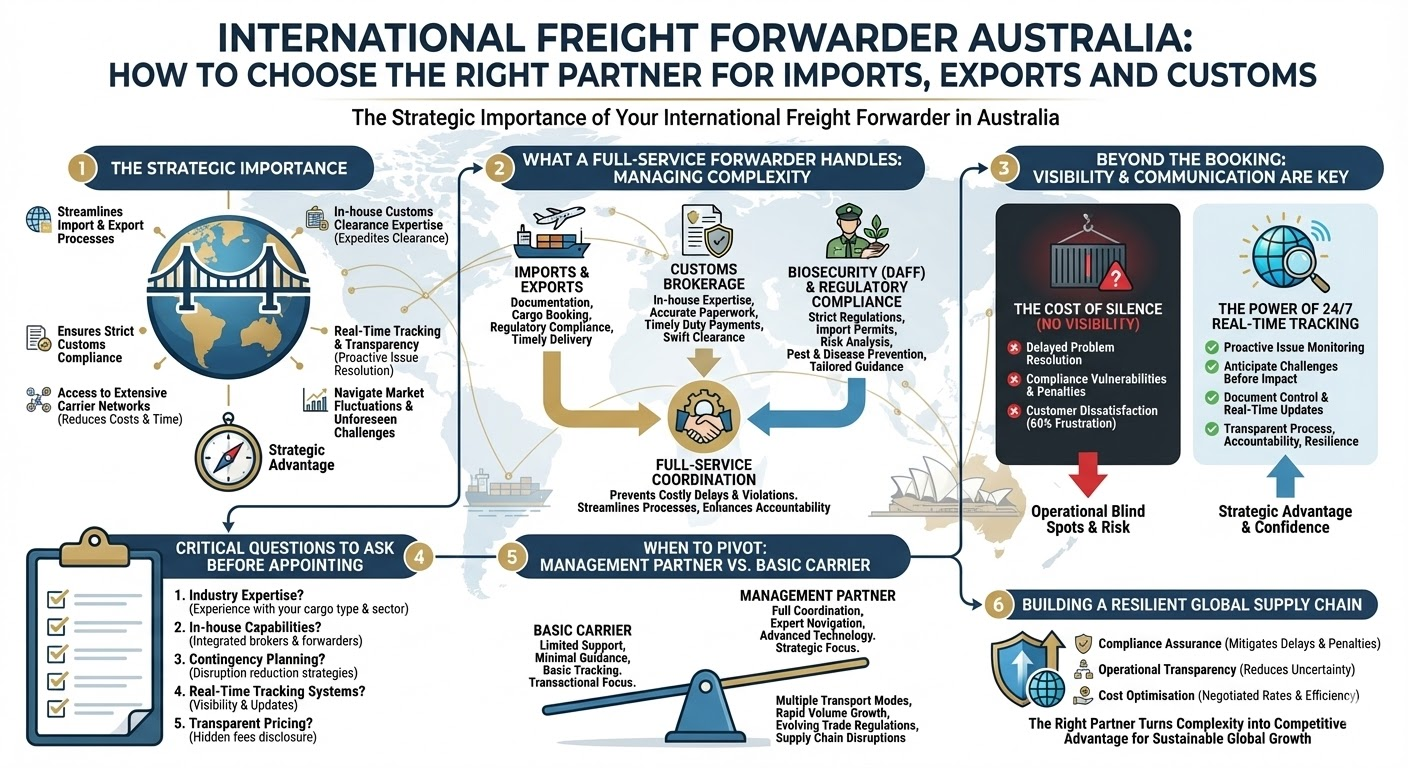
The Strategic Importance of Your International Freight Forwarder in Australia

Selecting a competent international freight forwarder shapes the efficiency and compliance of your entire supply chain. In Australia’s regulated environment, the right partner streamlines import and export processes while ensuring adherence to strict customs requirements.
A proficient freight forwarder provides access to extensive carrier networks, reducing shipping costs and transit times. Their in-house customs clearance expertise manages complex documentation, expediting clearance and minimising supply chain delays.

Read Article  

Domestic Freight Management vs Domestic Freight Forwarder: What’s the Difference for Australian Businesses?

Given Australia’s vast geography and dispersed population centres, the domestic logistics environment comprises a sophisticated network of road, rail, and air transport options that facilitate efficient goods movement across the continent.
Businesses manoeuvring through this terrain face complex decisions regarding route optimisation, carrier selection, and cost management.
Effective domestic freight management has become crucial for maintaining a competitive advantage. The Australian freight market responds to fuel price fluctuations, regulatory shifts, and demand variations, creating an environment in which strategic oversight is critical.

Read Article  

The Role of a Domestic Freight Forwarder in the Australian Market

Traversing Australia’s vast geography demands specialised expertise that domestic freight forwarders provide across the country’s complex logistics terrain. These professionals navigate the intricacies of domestic logistics by orchestrating seamless movement of goods—from small parcels to full truckloads—across diverse environments and distances.
Domestic freight forwarders in Australia serve as critical supply chain management partners, integrating multi-modal transport options including road, rail, and air services. They optimise delivery efficiency while managing compliance and regulatory requirements specific to domestic operations.

Read Article  
Scroll to Top

Error

The tracking number entered did not return any valid consignment. Please try again.

Freight Audit Guide

This field is for validation purposes and should be left unchanged.

contact us

This field is for validation purposes and should be left unchanged.
This field is hidden when viewing the form
Here is a radio button:
This field is hidden when viewing the form
Here is a checkbox: