Best Practice International Freight Forwarding in 2026

Relevant Articles

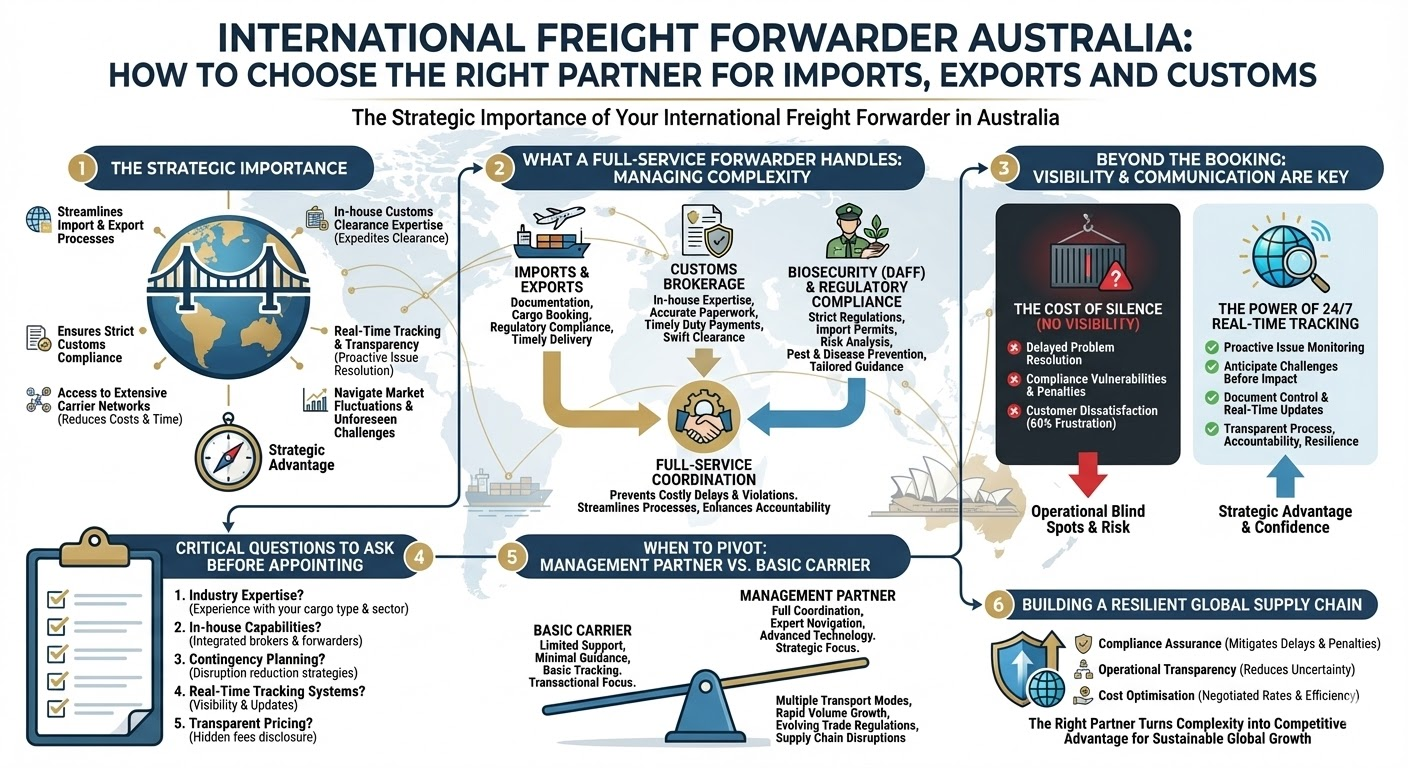
Best practice in international freight forwarding has shifted significantly over the past few years. What worked in stable conditions no longer holds up under volatility.

In 2026, best practice starts with risk awareness. Understanding where risk sits — supplier reliability, port congestion, seasonal capacity pressure and documentation complexity — allows forwarders to plan rather than react.

Clear documentation standards are foundational. Errors here don’t just slow freight; they create compliance, safety and operational exposure. Best-practice forwarders invest time upfront to get this right.

Another hallmark of best practice is proactive communication. Customers shouldn’t hear about delays after they’ve already impacted operations. Forwarders should communicate risk early, even when outcomes aren’t fully known.

Visibility must also be purposeful. Dashboards alone don’t improve outcomes. Best practice means using data to drive decisions — adjusting routings, changing service levels or escalating issues before they affect downstream commitments.

Integration with domestic freight is also essential. International freight doesn’t end at the port or airport. Best-practice forwarders ensure the domestic leg is planned with the same intent and discipline as the international movement.

Finally, partnership defines best practice. International freight forwarding isn’t about moving boxes — it’s about supporting the customer’s wider operation.

In 2026, the best outcomes aren’t achieved through speed alone. They’re achieved through control, clarity and ownership.

Share This Post

Facebook
LinkedIn

More News

For thought-provoking insights and the latest company news.

HOW TO CHOOSE A FREIGHT MANAGEMENT PARTNER IN AUSTRALIA

The modern business landscape is characterised by a relentless pace, evolving consumer expectations, and a constant battle for competitive advantage. For Small and Medium-sized Enterprises (SMEs), navigating these complexities can be particularly challenging, especially when it comes to the final leg of delivery. Last-mile logistics, the critical but often costly process of getting products from a distribution hub to the end customer, has become a significant pain point. Escalating surcharges, driven by a confluence of factors, are increasingly squeezing SME profit margins, threatening their ability to compete. However, a strategic paradigm shift towards “elastic logistics” offers SMEs a powerful, often overlooked, weapon to combat these rising costs and thrive in a dynamic market. This article explores how adopting an elastic approach to logistics can transform delivery challenges into opportunities, providing SMEs with the agility and resilience needed to succeed.

Read Article  

WHEN SHOULD AUSTRALIAN BUSINESSES OUTSOURCE FREIGHT MANAGEMENT?

The modern business landscape is characterised by a relentless pace, evolving consumer expectations, and a constant battle for competitive advantage. For Small and Medium-sized Enterprises (SMEs), navigating these complexities can be particularly challenging, especially when it comes to the final leg of delivery. Last-mile logistics, the critical but often costly process of getting products from a distribution hub to the end customer, has become a significant pain point. Escalating surcharges, driven by a confluence of factors, are increasingly squeezing SME profit margins, threatening their ability to compete. However, a strategic paradigm shift towards “elastic logistics” offers SMEs a powerful, often overlooked, weapon to combat these rising costs and thrive in a dynamic market. This article explores how adopting an elastic approach to logistics can transform delivery challenges into opportunities, providing SMEs with the agility and resilience needed to succeed.

Read Article  
Scroll to Top

Error

The tracking number entered did not return any valid consignment. Please try again.

Freight Audit Guide

This field is for validation purposes and should be left unchanged.

contact us

This field is for validation purposes and should be left unchanged.
This field is hidden when viewing the form
Here is a radio button:
This field is hidden when viewing the form
Here is a checkbox: