WHEN SHOULD AUSTRALIAN BUSINESSES OUTSOURCE FREIGHT MANAGEMENT?

Relevant Articles

Many businesses manage freight internally for longer than they should.

Over time, this creates inefficiencies and operational risk.

This article explains when Australian businesses should consider outsourcing freight management.


THE HIDDEN COST OF INTERNAL FREIGHT MANAGEMENT

Common hidden costs include:

– Time spent chasing carriers

– Inconsistent delivery performance

– Poor visibility

– Reactive problem solving

These costs often outweigh the perceived savings.


EARLY VS GROWTH STAGE FREIGHT

Early-stage freight is simple.

Growth-stage freight introduces complexity across carriers, regions, and volumes.


SIGNS IT IS TIME TO OUTSOURCE

– Multiple carriers with no central control

– Limited freight visibility

– Increasing customer delivery issues

– Freight distracting core staff

– National or regional expansion


WHAT FREIGHT MANAGEMENT REPLACES

Outsourcing replaces workload, not control.

It removes coordination, chasing, and reporting burden while retaining oversight.


FREIGHT MANAGEMENT VS INTERNAL HIRES

Internal hires often lack scale and coverage.

Freight management provides immediate access to systems, carriers, and expertise.


WHO BENEFITS MOST

Freight management suits:

– Manufacturers

– Distributors

– Importers and exporters

– Multi-site businesses


WHAT BUSINESSES GAIN

– Consistent performance

– Improved visibility

– Reduced operational friction

– Scalable logistics capability


FINAL THOUGHT

Outsourcing freight management is not losing control.

It is shifting freight from reactive handling to strategic management.


Share This Post

Facebook
LinkedIn

More News

For thought-provoking insights and the latest company news.

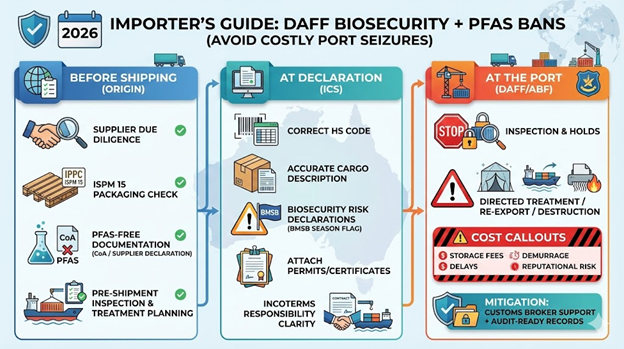
A 2026 Importer’s Guide to DAFF Biosecurity & PFAS Bans: Avoiding Costly Port Seizures.

Australia’s import landscape is in constant flux, presenting both opportunities and significant challenges for businesses relying on international trade. Navigating this evolving terrain demands more than just efficient logistics; it requires a deep understanding of stringent biosecurity protocols and an awareness of emerging chemical regulations. The Australian government, through bodies like the Department of Agriculture, Fisheries and Forestry (DAFF) and the Australian Border Force (ABF), is progressively enhancing measures to protect our unique environment, agricultural industries, and public health. This heightened regulatory environment means the margin for error has diminished, making proactive compliance not just a recommendation, but a critical imperative for preventing costly cargo seizures, operational disruptions, and reputational damage. Understanding and adapting to these changes is key to not only avoiding penalties but also to shipping smarter, more reliably, and ultimately, more profitably.

Read Article  

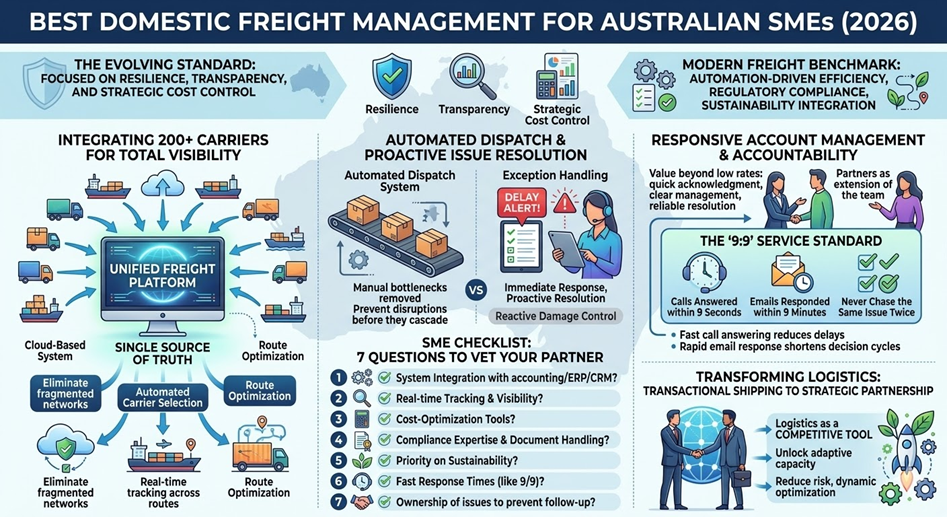
The Evolving Standard for “Best” Domestic Freight Management

The definition of “best” in domestic freight management has shifted fundamentally. In 2026, excellence extends beyond securing the lowest rates to encompassing resilience, transparency, and strategic cost control.
For Australian SMEs, freight visibility in Australia represents a critical competitive advantage, enabling real-time shipment tracking and improved operational transparency. This visibility directly supports customer satisfaction and operational reliability.

Read Article  
Scroll to Top

Error

The tracking number entered did not return any valid consignment. Please try again.

Freight Audit Guide

This field is for validation purposes and should be left unchanged.

contact us

This field is for validation purposes and should be left unchanged.
This field is hidden when viewing the form
Here is a radio button:
This field is hidden when viewing the form
Here is a checkbox: