New Financial Year, New Freight Strategy

Relevant Articles

New Financial Year, New Freight Strategy: 5 Logistics Moves to Set You Up for Success

The new financial year is more than just a line in your accounting system — it’s an opportunity to reset your logistics strategy with purpose. After all, your freight network isn’t “set and forget.” What worked last year might not get you where you need to go in FY25.

Whether you’ve grown, downsized, diversified, or hit a few bumps in the road, your freight approach needs to reflect your current business reality — not just historical habits.

Here are 5 logistics moves every forward-thinking business should consider in the new financial year:

1. Recalibrate Freight to Business Goals

If your growth strategy for FY25 involves new markets, products, or delivery models, your freight network needs to support that — not slow it down. Start the year by ensuring your shipping modes, carrier mix, and fulfilment footprint are aligned with your ambitions.

2. Review and Renegotiate Your Freight Agreements

Carrier terms, pricing structures, and service levels should be reviewed annually. Locking in last year’s rates might sound safe — but what if there’s a better structure available? At Clique, we often uncover cost-saving opportunities or service upgrades simply by reviewing what’s already in place.

3. Learn from the Data

Use last year’s freight trends as a compass. Where were your delays, cost spikes, or customer complaints? Which routes were most reliable? What peak periods stretched your capacity? A smart FY25 plan is built on real operational insights, not guesswork.

4. Build Flexibility Into the System

Logistics is volatile — and agility matters more than ever. Can your current setup flex if demand surges, a port is congested, or you need to pivot sourcing? If not, it’s time to introduce contingency options and capacity buffers.

5. Bake in Accountability and Transparency

If you’re chasing down carriers, checking spreadsheets for delays, or doing follow-ups for follow-ups… that’s not a scalable system. Look for logistics partners who own the outcome, offer clear SLAs, and provide proactive communication. (Yes — like us.)

Let FY25 Be the Year of Smarter Freight

At Clique Logistics, we help businesses step into the new financial year with confidence. Through tailored strategy reviews, real-time performance data, and our 9:9 Never Promise, we make logistics a source of strength — not stress.

Ready to set your FY25 freight strategy up for success?

We’ll answer your call in 9 seconds. Respond to your email in 9 minutes. And never make you follow up on the same issue twice.

Share This Post

Facebook
LinkedIn

More News

For thought-provoking insights and the latest company news.

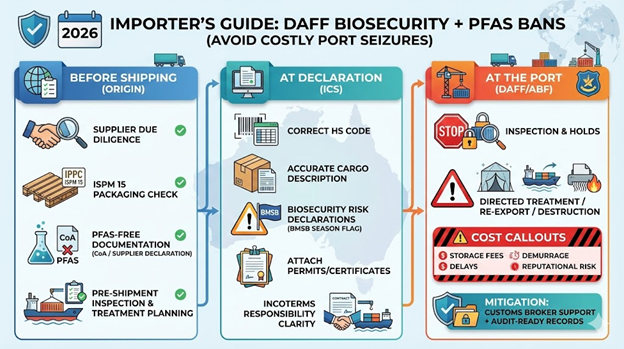
A 2026 Importer’s Guide to DAFF Biosecurity & PFAS Bans: Avoiding Costly Port Seizures.

Australia’s import landscape is in constant flux, presenting both opportunities and significant challenges for businesses relying on international trade. Navigating this evolving terrain demands more than just efficient logistics; it requires a deep understanding of stringent biosecurity protocols and an awareness of emerging chemical regulations. The Australian government, through bodies like the Department of Agriculture, Fisheries and Forestry (DAFF) and the Australian Border Force (ABF), is progressively enhancing measures to protect our unique environment, agricultural industries, and public health. This heightened regulatory environment means the margin for error has diminished, making proactive compliance not just a recommendation, but a critical imperative for preventing costly cargo seizures, operational disruptions, and reputational damage. Understanding and adapting to these changes is key to not only avoiding penalties but also to shipping smarter, more reliably, and ultimately, more profitably.

Read Article  

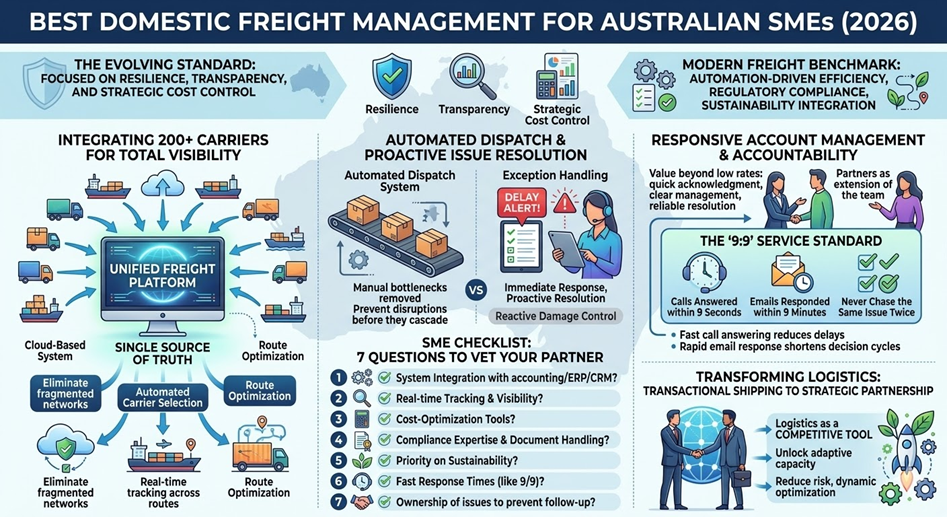
The Evolving Standard for “Best” Domestic Freight Management

The definition of “best” in domestic freight management has shifted fundamentally. In 2026, excellence extends beyond securing the lowest rates to encompassing resilience, transparency, and strategic cost control.
For Australian SMEs, freight visibility in Australia represents a critical competitive advantage, enabling real-time shipment tracking and improved operational transparency. This visibility directly supports customer satisfaction and operational reliability.

Read Article  

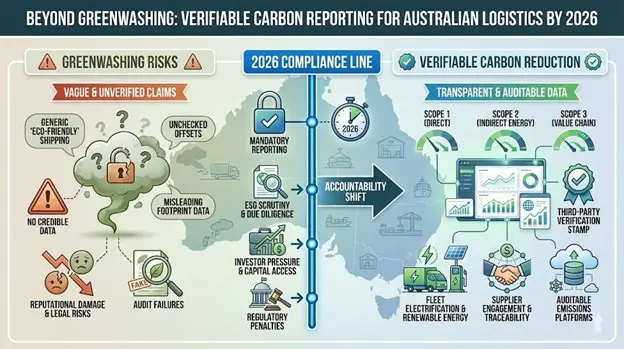
Beyond Greenwashing: Measurable Carbon Reporting for Australian Logistics in 2026.

The year 2026 is fast approaching, marking a critical juncture for the Australian logistics sector. As the global imperative for sustainability intensifies, the industry faces unprecedented pressure to demonstrate tangible carbon reduction, moving beyond superficial claims towards genuine, verifiable achievements. In Australia, this transition is not merely an Environmental responsibility; it’s a strategic necessity for business resilience, market competitiveness, and future growth. Companies that embrace this shift proactively will not only mitigate climate risk but also unlock significant competitive advantages. Those that falter risk being left behind, accused of greenwashing, and facing substantial reputational and financial consequences. This blueprint provides a clear roadmap for Australian logistics businesses to achieve verifiable carbon reduction by 2026, ensuring compliance, building trust, and securing long-term success.

Read Article  
Scroll to Top

Error

The tracking number entered did not return any valid consignment. Please try again.

Freight Audit Guide

This field is for validation purposes and should be left unchanged.

contact us

This field is for validation purposes and should be left unchanged.
This field is hidden when viewing the form
Here is a radio button:
This field is hidden when viewing the form
Here is a checkbox: