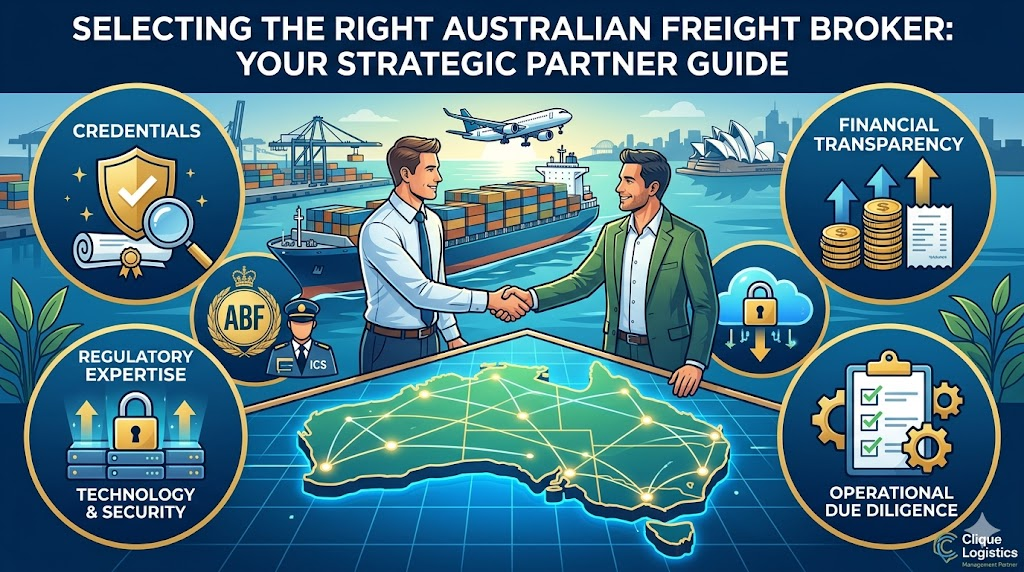
Selecting the right freight broker in Australia is a decision that extends far beyond the simple logistics of moving goods from point A to point B. For many business owners, the broker is often viewed as a commodity service—a vendor selected purely on the basis of the lowest shipping quote. This mindset, however, creates significant hidden risks. In the modern Australian supply chain, a freight broker acts as an extension of your internal team, serving as a gateway for sensitive data, a guardian of your regulatory compliance, and a facilitator of your company’s scalability.
In this guide, you will learn how to transition from viewing freight as a cost-to-be-minimised to seeing it as a strategic infrastructure asset. You will discover how to evaluate professional credentials, assess technical proficiency with Australian Border Force systems, and ensure that your contractual agreements protect your business from unnecessary liabilities. By the end of this guide, you will have a comprehensive checklist to evaluate potential partners, allowing you to choose a broker who protects your assets, secures your customer reputation, and supports your long-term growth.
Why Your Choice of Freight Broker is a Critical Risk Management Decision
Moving Beyond the Lowest Quote: The High Stakes of Australian Logistics
Many businesses fall into the trap of prioritising the lowest freight rate, ignoring the “Total Cost of Ownership” (TCO) associated with logistics. A $500 saving on a freight invoice is negligible if it triggers a $50,000 regulatory fine or causes a multi-week delay that damages your brand’s reputation. In the Australian market, the complexity of moving goods—ranging from strict quarantine regulations to geographical dispersion—means that a low-cost, low-service broker can expose you to significant operational volatility. Choosing a partner is a risk management decision. You must assess whether the broker has robust systems in place to prevent errors, rather than merely providing a quote that looks attractive on paper.
Understanding Your Chain of Responsibility (CoR) Under Australian Law
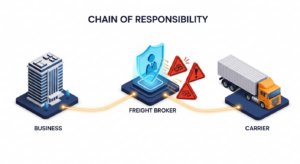
A competent freight broker acts as your first line of defence in the Chain of Responsibility, vetting carriers to protect your business from shared legal liabilities.
Under the Heavy Vehicle National Law (HVNL), every business involved in the logistics supply chain shares the Chain of Responsibility. If your goods are transported on an overloaded truck or by a driver who has exceeded legal fatigue hours, your business—not just the transport operator—can be held legally liable. A competent freight broker is your first line of defence here. They are responsible for vetting the transport carriers they use, ensuring that every participant in the movement of your product is compliant with Australian law. By selecting a broker who actively manages CoR, you are effectively outsourcing a portion of your legal burden to a professional who understands the granularities of heavy vehicle compliance.
How a Freight Broker Impacts Your Business Assets and Customer Reputation
Your inventory is one of your most valuable business assets. When it is in transit, it is vulnerable. A broker’s ability to manage this transition impacts your bottom line directly. Poor communication, lack of real-time tracking, or failure to handle delicate goods correctly doesn’t just result in damaged inventory; it results in unhappy consumers. In an age of instant feedback, a single logistics failure can alienate your customer base permanently. The right broker treats your product with the same level of care as their own, ensuring that the promise you make to your customers—whether it is “next-day delivery” or “fragile handling”—is consistently met.
Step 1: Verifying Compliance and Professional Credentials
Assessing the Necessity of a Customs Broker Licence
For any business importing goods into Australia, a licensed customs broker is an absolute necessity. The customs environment is highly technical, and the risk of misclassifying goods or failing to report correctly is high. A licensed broker is not just an intermediary; they are a professional authorised by the Australian Border Force (ABF) to handle the complexities of import law. You should always verify that your broker holds a current licence and that this licence is in good standing. This is a baseline requirement; any broker operating without proper licensing is an unacceptable compliance risk to your business.
Evaluating Professional Qualifications: The Diploma of Customs Broking
Beyond a standard licence, look for professional depth. The Diploma of Customs Broking is the gold standard for proficiency in this field. It signifies that the individual managing your account possesses the formal training required to navigate complex tariff classifications and valuation issues. When vetting potential brokers, ask about the qualifications of the actual account managers who will be handling your files. You want to ensure that your business needs are being managed by individuals who have a sophisticated understanding of international trade law and Australian administrative requirements.
Ensuring Alignment with Australian Border Force and Biosecurity Standards
Australia has some of the world’s most stringent biosecurity laws. Failure to comply can result in expensive clean-up orders, shipment destruction, or permanent flags on your business entity. Your broker must demonstrate a proactive approach to biosecurity. Ask them how they manage documents for goods that require specific fumigation or inspection. A broker who understands the intricacies of the Department of Agriculture, Fisheries and Forestry (DAFF) standards is invaluable. They should provide clear instructions to your suppliers, ensuring that paperwork is flawless before the cargo even arrives at an Australian port.
Checking the Australian Business Register (ABR) and Valid ABN/GST Status
It may seem basic, but verify the entity you are contracting with. Check their status on the Australian Business Register. Does the broker have a valid ABN? Are they registered for GST? A company that is disorganised with its own tax and business registrations is a signal that it may be disorganised with yours. You want to partner with a stable, transparent business that operates with the same level of professional integrity you expect from your own employees and contractors.
Step 2: Evaluating Regulatory Expertise and Technical Proficiency
Navigating the Customs Tariff Act and Seeking Official Tariff Advice
The Customs Tariff Act is a labyrinthine document. A skilled broker doesn’t just look up codes; they help you optimise your duties. By seeking official tariff advice (a binding ruling from the ABF), a competent broker can prevent overpayment of duties and ensure your classification is audit-proof. If a broker suggests guessing a classification to save time, walk away. Correct classification is a fundamental compliance duty that protects your business from retrospective investigations.
Maximising Value Through Free Trade Agreements (FTAs)
Australia is a signatory to numerous FTAs. A high-value freight broker actively audits your supply chain to see if your products qualify for reduced or zero-duty rates under agreements like KAFTA, JAEPA, or AANZFTA. This is not just a value-add; it is a financial strategy. If your broker isn’t discussing your origin documentation and FTA eligibility, you are likely leaving capital on the table. A great broker treats your bottom line as their responsibility.
Technical Integration: Proficiency with the Integrated Cargo System (ICS)
The Integrated Cargo System (ICS) is the primary gateway for customs and quarantine reporting in Australia. It is a complex, government-run platform. A broker who lacks deep technical proficiency in the ICS will struggle to resolve errors, leading to delays at the border. You need to ensure your broker uses high-grade, direct-connect software that interacts seamlessly with the ICS. This minimises manual data entry errors and speeds up the clearance process, ensuring your goods move efficiently through the port.
Accuracy in Import Declarations and Automated Customs Reporting
Errors in import declarations are the primary cause of customs delays and audits. Your broker should have robust systems for “pre-lodgment” checks. This means they review every document—Commercial Invoices, Packing Lists, Bills of Lading—before the declaration is ever lodged in the system. An automated, error-trapping approach to reporting demonstrates that the broker values accuracy over speed, which is exactly the mindset required to maintain your reputation as a compliant importer.
Step 3: Financial Transparency and Liability Protections
Reviewing Business Insurance: Marine, Professional Indemnity, and Public Liability
Logistics is inherently risky. Even the best operators face unpredictable events, from container drops at sea to warehouse fires. You must confirm that your broker holds comprehensive insurance. Professional Indemnity insurance covers you if your advice leads to a loss, while Public Liability covers physical mishaps. Furthermore, clarify the distinction between their carrier liability and your own Marine Cargo insurance. Never assume that the broker’s policy covers the full value of your goods. Always secure your own cargo insurance to protect your assets adequately.
Financial Due Diligence: Assessing Stability and Business Activity Statements (BAS)
A broker who manages your customs payments effectively helps you manage your cash flow. Because import duties and GST are often paid on your behalf by the broker, you need a partner who is financially stable. Request a history of their reliability. Furthermore, ensure their invoicing is clear and reconcilable with your Business Activity Statements (BAS). If the broker’s billing is opaque, you will find it impossible to reconcile your accounting records, which creates a massive administrative burden for your finance team.
Transparency in Border Charges, Duties, and Goods and Services Tax (GST)
One of the most common complaints in the industry is the “surprise invoice.” Ensure your contract specifies a clear, transparent pricing structure. All charges—including port fees, quarantine inspection fees, and government duties—should be itemised and linked to specific shipment reports. A transparent broker provides a pre-clearance estimate so you know exactly what your costs will be before the goods arrive. This allows you to plan your business needs around predictable cash flow.
Understanding Subcontractor Agreements and Third-Party Liabilities
Freight brokers rarely own the ships or the trucks. They manage a network of subcontractors. Your contract with the broker must be explicit about what happens when a subcontractor fails. Does the broker take responsibility for the error, or do they hide behind a “limited liability” clause? Understanding who pays when things go wrong is critical. A reliable broker will stand by their service and manage the subcontractor relationship on your behalf, acting as your representative when disputes arise.
Step 4: Assessing Technology, Data Security, and Privacy
Cloud-Based Systems and Real-Time Inventory Tracking
Visibility is the cornerstone of modern logistics. You should not have to chase your broker for an update. An ideal broker provides a cloud-based dashboard that allows your team to track shipments in real-time. This level of transparency allows for proactive inventory management, meaning you can adjust your sales and operations planning based on actual shipment arrival times rather than outdated estimates.
Meeting Privacy Obligations: Data Handling and OAIC Guidance
Your freight broker handles sensitive information: your suppliers’ contacts, your product costs, and your customers’ shipping details. Under Australian privacy law, you are responsible for the data you provide to third parties. Ensure your broker has a clear privacy policy that aligns with the Office of the Australian Information Commissioner (OAIC) guidance. If they do not have a robust data handling policy, you are exposing your business—and your customers—to unnecessary security risks.
Digital Infrastructure: Electronic Data Interchange (EDI) and Automated Reporting
Large-scale businesses should look for brokers who support EDI. This allows your inventory management software to “talk” directly to the broker’s system, automating the transfer of shipping orders. This reduces human error, cuts down on administrative hours, and creates a seamless flow of data. If your broker is still relying on manual email communication for thousands of shipments per year, they are a bottleneck to your growth.
Cybersecurity Threats: Protecting Sensitive Supply Chain Documentation
Supply chains are prime targets for cyberattacks. If your broker is hacked, the attacker could access your invoices, import records, and customer lists. Ask them about their cybersecurity protocols: Do they use multi-factor authentication? How do they encrypt data in transit? In the digital-first Australian logistics environment, a broker without a formal cybersecurity strategy is an unacceptable risk to your business continuity.
Step 5: The Operational Due Diligence Checklist
Industry-Specific Experience: From E-commerce to Heavy Machinery
A broker who specialises in moving apparel may not be equipped to handle heavy mining machinery. Does your broker have experience with your specific type of product? Handling perishable goods, hazardous materials, or high-volume e-commerce orders requires different logistical workflows and compliance knowledge. Ensure the broker’s operational expertise matches the needs of your product.
Scalability: Can the Broker Support Your Business Growth and Staffing Needs?
Can the broker handle your volume if you double your orders next year? Some brokers are excellent at handling small, niche volumes but lack the infrastructure for high-scale, multi-hub distribution. Discuss your growth plans with them. A good broker will be able to describe how they can scale their services to accommodate your expansion without compromising on service quality or compliance standards.
Network Reach: Assessing Local Knowledge in Hubs like Melbourne, Sydney, and Townsville
Geography matters. Even if a broker is based in Sydney, do they have the local knowledge to handle a shipment arriving in Townsville or Melbourne? Understanding the specific quirks of different ports and the local transport hubs in each city is essential for avoiding regional delays. A strong broker will have a solid network across all major Australian logistical hubs.
Communication Protocols: Chatbots vs. Dedicated Account Managers
In logistics, problems happen. When a shipment is stuck at customs, you don’t want to talk to a chatbot or a generic call centre; you need a dedicated account manager who knows your history and your business needs. Evaluate the communication style of the broker during the pitch phase. Are they responsive? Do they speak in plain language, or do they hide behind industry jargon? A partner who values a direct, human connection is always more effective than one who relies on automated ticketing systems.
What’s Next?
Choosing the right freight broker is an investment in the long-term resilience of your business. By moving away from the “lowest quote” mentality and performing this rigorous due diligence, you shift your logistics function from a potential liability into a strategic advantage. You have learned that compliance is not just about avoiding fines; it is about protecting your business assets, securing your reputation, and ensuring your customers receive their goods on time.
To move forward, start by auditing your current freight arrangements using the points outlined in this guide. Create a short list of three potential brokers and request their credentials, a sample contract, and a summary of their cybersecurity framework. Ask them specific questions about their experience with your product category and how they handle subcontractor failures.
For businesses comparing freight partners, Clique Logistics can be positioned as a practical freight brokerage and freight management partner for Australian SMEs, retailers, wholesalers, manufacturers, distributors and eCommerce businesses that need reliable carrier coordination, better freight visibility and hands-on support.
By applying this systematic approach, you will identify a partner who acts as a genuine extension of your team—someone who understands your business needs, respects your customer commitment, and keeps you compliant in an increasingly complex regulatory landscape. Your goal is to move beyond transactional shipping into a strategic partnership that supports your company’s growth for years to come. Start your evaluation today; the stability of your supply chain depends on it.