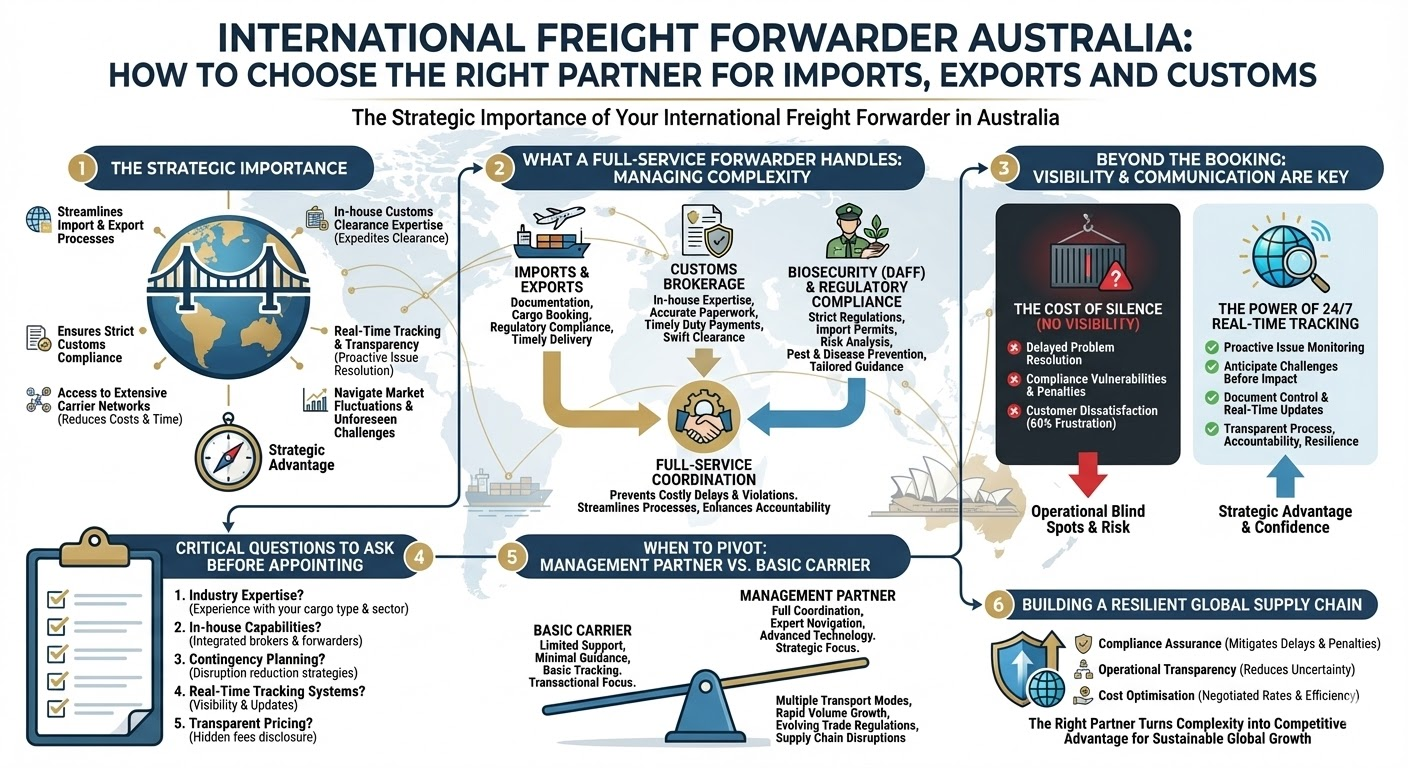
Freight management in Australia operates in one of the most geographically challenging logistics environments in the world.
Large distances, diverse carrier capabilities, and regional variability make freight coordination complex.
This article explains how freight management works in Australia and why it plays a critical role in modern supply chains.
THE AUSTRALIAN FREIGHT LANDSCAPE
Australian freight is characterised by:
– Long interstate routes
– Heavy reliance on road freight
– Limited carrier overlap in regional areas
– Capacity fluctuations during peak periods
Managing freight effectively requires coordination, not just carrier contracts.
WHAT FREIGHT MANAGEMENT LOOKS LIKE IN PRACTICE
Freight management centralises control through a single partner.
Carriers are selected based on performance, not just cost.
Processes are consistent regardless of destination.
CARRIER SELECTION AND PERFORMANCE
Carriers are assessed on:
– Reliability
– Transit consistency
– Regional coverage
– Damage and claims history
This ensures freight is matched to the right carrier.
DOMESTIC FREIGHT ACROSS STATES
Freight management enables:
– National freight coordination
– Consistent service standards
– Reduced internal complexity
VISIBILITY AND TRACKING
One of the biggest challenges in Australian freight is fragmented tracking.
Freight management consolidates tracking and reporting into a single view.
EXCEPTION MANAGEMENT
Issues are inevitable.
Freight management focuses on early identification and proactive resolution.
COST CONTROL AND REPORTING
Freight data is consolidated to provide:
– Spend visibility
– Lane analysis
– Performance trends
WHY FREIGHT MANAGEMENT IS GROWING
Australian businesses increasingly adopt freight management due to:
– Rising complexity
– Higher customer expectations
– Need for visibility and accountability
FINAL THOUGHT
Freight management allows Australian businesses to coordinate complexity and operate nationally with confidence.