In today’s interconnected global economy, the efficiency of your supply chain is a critical competitive advantage. Yet, for many businesses, the journey of international freight remains a black box, riddled with uncertainty and blind spots. The shocking reality is that only 6% of companies report having complete end-to-end supply chain visibility, leaving the vast majority vulnerable to disruptions. This gap between the need for information and the reality of fragmented data creates significant operational risks and hidden costs. The demand for a single source of truth—a tool that offers genuine, real-time visibility across all carriers and modes—has never been more urgent. This article compares the landscape of international freight-tracking tools and explains why a new standard is emerging to address this challenge.
The Critical Need for Global Visibility in International Freight
Navigating the Complexities of Modern Supply Chains
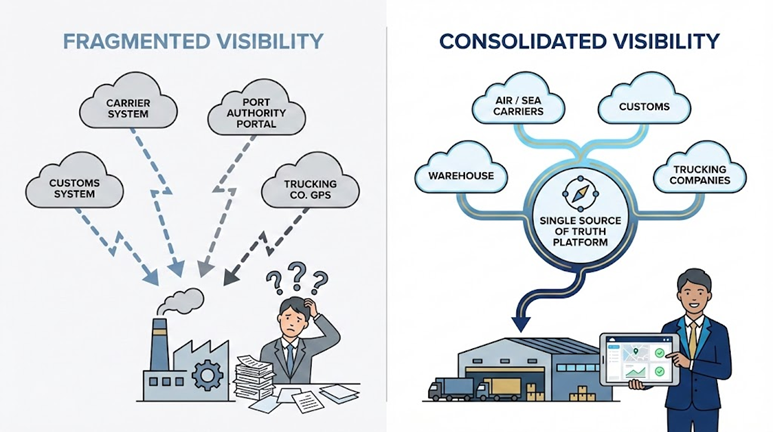
The difference between a fragmented supply chain with data silos and a consolidated view from a single platform.
Modern supply chain operations are inherently complex. A single international shipment can involve multiple carriers, various modes of transport (ocean, air, land), numerous handoffs, and critical checkpoints like customs clearance. Each participant in this chain often uses its own disparate system, creating data silos. This fragmentation makes it nearly impossible for a freight forwarding professional or logistics manager to get a clear, consolidated view of a shipment’s journey, turning proactive management into a constant reactive scramble.
The High Stakes of Delays and Disruptions
When visibility is poor, the consequences are severe. A delay at a port, a missed connection, or a customs hold can trigger a cascade of adverse effects. These include increased demurrage and detention fees, production line shutdowns due to missing components, and damaged customer relationships from broken delivery promises. In an environment where maritime trade growth is expected to slow, every efficiency gain and risk-mitigation measure becomes paramount for maintaining profitability and market position.
From Reactive to Proactive: The Demand for Real-Time Visibility
The market no longer tolerates ambiguity. Customers, partners, and internal stakeholders demand immediate, accurate answers to shipment status questions. This has shifted the industry’s focus from reactive problem-solving (finding out what went wrong) to proactive management (anticipating and preventing issues). Achieving this requires accurate real-time visibility—not data that is hours or days old, but live information that empowers decision-makers to act swiftly and strategically to optimise routes and maintain performance.
Key Challenges in International Freight Tracking
The core challenges in achieving global visibility are multifaceted. They include a lack of data standardisation across carriers, reliance on manual processes such as phone calls and emails for updates, and the technical difficulty of integrating dozens of carrier websites and portals. Furthermore, basic tracking tools often provide only superficial milestone updates, failing to capture the granular, in-transit details needed for effective supply chain management.
Understanding the Landscape of International Freight Tracking Tools
Traditional Tracking Methods and Their Limitations (e.g., manual calls, carrier websites)
The most basic tracking methods are also the most inefficient. Manually checking individual carrier websites with a tracking number is time-consuming and doesn’t scale. A single multimodal shipment could require logging into four or five different portals, none of which communicate with each other. This approach provides a fragmented, lagging view of the supply chain and consumes valuable staff hours that could be better spent on higher-value activities.
The Rise of Logistics Software and Transport Management Systems
To combat this fragmentation, Transport Management Systems (TMS) and other logistics software emerged. These platforms aimed to centralise some operational data, offering a step up from purely manual methods. While an improvement, many of these systems still struggle with proper real-time data integration from external sources. Their tracking capabilities are often add-ons rather than core, deeply integrated features, leading to persistent data gaps and latency issues.
Basic Shipment Tracking Solutions: What They Offer (e.g., tracking number lookups, generic notifications)
Standalone tracking solutions represent another tier of tools. These applications often aggregate data from multiple carriers into a single dashboard. While useful, they typically offer limited depth. They rely on standard carrier milestone updates (e.g., “departed port,” “arrived at hub”) and provide generic notifications. They rarely offer the contextual, enriched data needed to understand the why behind a delay or to accurately predict future milestones, functioning more as a logbook than an intelligent visibility tool.
Enterprise Resource Planning (ERP) and Supply Chain Management Suites
At the highest level, Enterprise Resource Planning (ERP) systems provide a holistic view of a business, connecting finance, inventory, and logistics. When a supply chain management module is integrated, it creates a robust foundation. However, the external visibility component—the real-time tracking of goods in transit with third-party carriers—can still be a weak point unless the ERP is specifically designed with deep, native logistics integration capabilities, such as those offered by WiseTech Global.
Introducing Cargo Neo: A New Standard for Global Visibility
Defining Cargo Neo: A Dedicated Platform for Unrivalled Global Visibility
Cargo Neo is not just another tracking dashboard; it is an advanced visibility application built within the robust CargoWise ecosystem. Developed by WiseTech Global, CargoWise is a leading enterprise resource planning platform for the logistics industry. Cargo Neo serves as a dedicated command centre, designed to provide freight forwarding professionals, Third-Party Logistics (3PL) providers, and their customers with a single, unified view of all global shipments in real time.
Our Philosophy: Specialised Visibility for Empowered Supply Chain Operations
The philosophy behind Cargo Neo is that accurate visibility empowers better supply chain operations. Generic tracking is no longer sufficient. By providing a specialised, deeply integrated tool, Cargo Neo enables logistics professionals to move beyond simply watching dots on a map. It equips them with granular data and contextual insights to manage exceptions, proactively communicate with clients, and optimise the overall performance of their logistics network.
Cargo Neo’s Core Promise: Transforming Data into Actionable Insights
The core promise of Cargo Neo is transformative yet straightforward: to convert the chaotic flood of raw logistics data into clear, actionable intelligence. It goes beyond telling you where a shipment is. It aims to tell you what that location means for your schedule, your costs, and your customer commitments. This focus on actionable insights is what elevates Cargo Neo from a passive monitoring tool to an active supply chain management asset.
How Cargo Neo Achieves Unrivalled Global Visibility
Comprehensive Data Aggregation and Integration
Cargo Neo’s power begins with its ability to aggregate data from an unparalleled range of sources. Leveraging robust APIs, it pulls real-time information directly from a vast network of air, sea, and land carriers. This data is unified with information already within the CargoWise platform, such as customs declarations, warehouse management updates, and transport orders. This creates a single, comprehensive record for every shipment, eliminating data silos.
Cutting-Edge Tracking Technologies for Granular Insights
Beyond standard milestone messages, Cargo Neo incorporates advanced data sources to provide a more detailed picture. This can include vessel GPS, flight status data, and port terminal information. By synthesising these multiple data streams, the application can offer more accurate estimated times of arrival (ETAs) and detect potential deviations from the plan long before a carrier might issue a formal notification, enabling early intervention.
Intuitive and Dynamic User Experience
All this complex data is presented in a clean, intuitive, and highly visual interface. Users can view shipments on a live map, filter by status, customer, or route, and drill down into detailed timelines for any consignment. The platform is designed for ease of use, ensuring that logistics coordinators and customers alike can quickly find the information they need without extensive training, transforming complex supply chain data into an easily digestible format.
Key Differentiators: Why Cargo Neo Stands Apart
Beyond Basic Tracking: Focus on Proactive Supply Chain Management
Unlike tools that merely report past events, Cargo Neo is built for proactive supply chain management. Its intelligent notification system can be configured to alert users to potential issues—such as a vessel slowing down or a container missing its loading window—before they become critical problems. This allows managers to arrange alternative routes or adjust downstream planning, turning potential crises into managed exceptions.
Unparalleled Data Accuracy and Reliability
Because Cargo Neo is deeply integrated with the CargoWise ERP, it benefits from a verified and validated data foundation. Shipment details are not pulled from external sources; they are cross-referenced with operational data in CargoWise. This direct link to the core freight forwarding and customs clearance processes ensures greater accuracy and reliability than standalone platforms that lack this rich contextual data.
Actionable Insights for Strategic Decision-Making (Business Intelligence)
Cargo Neo is more than a visibility tool; it’s a business intelligence engine. Analysing historical and real-time tracking data helps identify trends in carrier performance, lane efficiency, and dwell times. These insights enable logistics managers to make more informed decisions about carrier selection, route optimisation, and overall network strategy, driving long-term improvements and cost savings.
User-Centric Design and Customisation
Recognising that every business has unique needs, Cargo Neo offers significant customisation. Users can create custom views, reports, and notification rules tailored to their specific operational requirements or client service level agreements. This flexibility ensures the platform delivers relevant, high-value information, filtering out noise and focusing on what matters most to each user.
Enhanced Security and Data Integrity
As part of the globally trusted CargoWise platform, Cargo Neo adheres to the highest standards of data security and integrity. All data is managed within a secure, robust infrastructure, ensuring that sensitive shipment information is protected. This provides peace of mind for logistics providers and their clients, who can trust the platform with their critical operational data.
The Tangible Benefits of Implementing Cargo Neo
Reducing Operational Costs and Improving Efficiency
By automating the tracking process and providing proactive alerts, Cargo Neo dramatically reduces the manual effort required to manage shipments. This frees up operational staff to focus on customer service and exception management. Furthermore, by enabling quicker responses to delays, it helps minimise costly detention and demurrage fees, directly impacting the bottom line.
Boosting Customer Satisfaction and Trust
Cargo Neo provides a branded, self-service portal that can be extended to end customers. This transparency empowers clients with the real-time visibility they demand, reducing their anxiety and building trust. It also reduces “where is my shipment?” calls and emails, improving the efficiency of customer service teams and enhancing the overall customer experience.
Mitigating Risks and Enhancing Regulatory Compliance
Improved visibility directly translates to reduced risk. Knowing the precise location and status of cargo helps manage inventory, prevent theft, and ensure compliance with regulatory requirements. For time-sensitive processes like customs clearance, accurate ETA data is crucial for preparing documentation in advance and avoiding costly delays at the border.
Optimising Inventory Management and Distribution
For businesses that rely on just-in-time inventory models, the predictive ETAs and real-time updates from Cargo Neo are invaluable. This enhanced visibility allows for better planning of warehouse labour, truck scheduling, and downstream distribution. It helps reduce safety stock levels, lower carrying costs, and create a more agile and responsive supply chain.
Conclusion
The international freight landscape is growing more complex, and the demand for clarity and control has never been greater. While many tools offer basic tracking, they often fail to deliver the comprehensive, real-time, and actionable intelligence required for modern supply chain management. Traditional methods are inefficient, and standalone applications lack the depth and integration to provide a truly unified view.
Cargo Neo, an integral part of the CargoWise platform from WiseTech Global, stands out for its genuinely unrivalled global visibility. It moves beyond reactive tracking by transforming disparate data streams into a single, intelligent command centre. By leveraging deep API integrations, enriching data with business intelligence, and focusing on proactive exception management, Cargo Neo empowers freight forwarding and logistics professionals not only to see their entire supply chain but also to actively manage and optimise it. Implementing Cargo Neo is a strategic step toward reducing costs, enhancing customer satisfaction, and building a more resilient, predictable, and competitive supply chain operation for the future.