The definition of “best” in domestic freight management has shifted fundamentally. In 2026, excellence extends beyond securing the lowest rates to encompassing resilience, transparency, and strategic cost control.
For Australian SMEs, freight visibility in Australia represents a critical competitive advantage, enabling real-time shipment tracking and improved operational transparency. This visibility directly supports customer satisfaction and operational reliability.
Simultaneously, freight cost optimisation has evolved from reactive negotiation to proactive intelligence. Successful operators utilise advanced platforms integrating multiple carriers, continuously auditing spend patterns to identify savings opportunities while maintaining service standards.
The modern benchmark demands automation-driven efficiency, regulatory compliance excellence, and sustainability integration.
SMEs that combine real-time visibility with structured cost optimisation—supported by human oversight and continuous improvement protocols—establish themselves as resilient, customer-centric logistics partners capable of adapting to market changes.
The Role of Technology: Why 2026 Demands Total Visibility
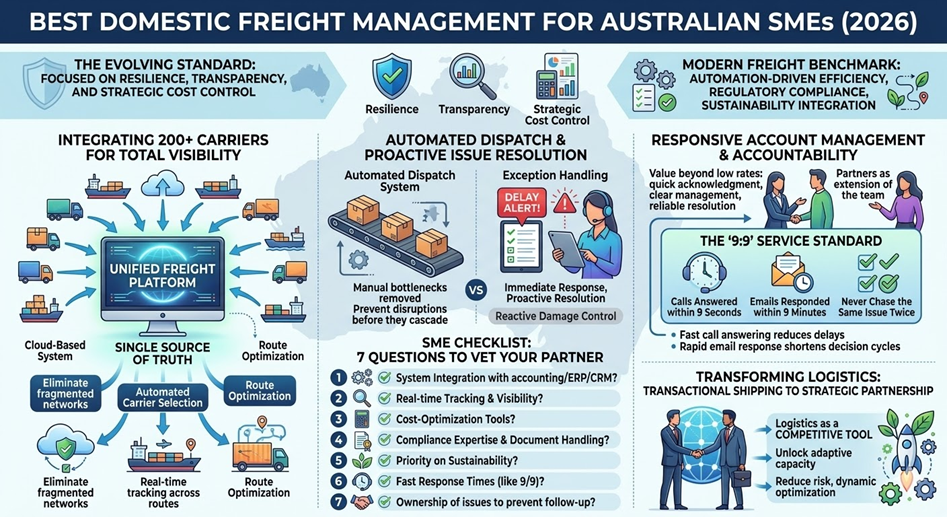
By 2026, SMEs managing domestic freight cannot afford fragmented carrier networks—integrating 200+ carriers into a unified system transforms logistics from chaotic coordination into streamlined operations.
Automated dispatch and real-time exception handling eliminate manual bottlenecks, enabling immediate response to disruptions before they cascade through supply chains.
This technological consolidation converts visibility from a competitive advantage into an operational necessity for SMEs competing in an increasingly demanding market.
Integrating 200+ Carriers into a Single Source of Truth
Managing over 200 carriers through disparate systems and disconnected communication channels represents a critical operational challenge that SMEs can no longer afford to ignore.
A unified platform consolidating all carriers into a single source of truth eliminates fragmentation and facilitates seamless decision-making across the best domestic freight management Australia has to offer.
Cloud-based freight management systems automate carrier selection and route optimisation, leveraging data analytics to reduce costs and improve delivery times.
This integration transforms how SMEs execute interstate freight solutions, providing real-time visibility across transport modes and routes.
Automated Dispatch and Real-Time Exception Handling
Automated dispatch systems have become non-negotiable for SMEs traversing Australia’s domestic freight environment in 2026. These systems eliminate manual bottlenecks, enabling seamless shipment processing across integrated carrier networks.
Real-time exception handling transforms reactive management into proactive resolution—when delays, misroutes, or capacity issues emerge, alerts trigger immediate intervention rather than post-incident damage control.
The competitive edge belongs to logistics partners who combine automation with human oversight. Exception handling systems flag anomalies instantly, while experienced teams address root causes within hours, not days.
This dual approach protects customer satisfaction and operational margins simultaneously.
For SMEs lacking internal logistics expertise, this integration delivers what matters most: visibility, speed, and reliability. Businesses no longer manage exceptions reactively; they prevent them systematically.
That’s what resilience looks like in modern freight management.
Why Account Management Matters More Than Cheap Rates
In 2026, responsive account management has become a defining differentiator in Australian freight logistics. For SMEs, the real value of a freight partner is not only found in rate cards or carrier access, but in how quickly issues are acknowledged, how clearly they are managed, and how reliably they are resolved.
Clique Logistics frames this service promise around a simple but powerful standard: calls answered within 9 seconds, emails responded to within 9 minutes, and a commitment that clients should never have to chase the same issue twice.
This approach changes account management from a passive support function into an active operational advantage. Instead of leaving clients to follow up repeatedly, strong logistics partners take ownership from the first contact, move quickly on exceptions, and protect internal teams from wasted time and disruption.
For Australian SMEs, that level of responsiveness matters. When delays, misroutes, urgent bookings, or customer updates arise, businesses need more than a low-cost provider. They need a logistics partner that acts like an extension of their team.
The “9:9” Service Standard: Redefining Logistics Responsiveness
The old assumption that the best freight outcome comes from the cheapest rate no longer reflects the realities of domestic logistics in Australia. Service quality, accountability, and speed of response now play a far greater role in long-term freight performance.
Clique Logistics expresses this through a practical service standard built on three promises:
- When you call, the team answers within 9 seconds
- When you email, the team responds within 9 minutes
- You should never have to chase the same issue twice
This standard reflects a broader truth about modern freight management: responsiveness is not a nice extra, it is part of operational resilience.
Fast call answering reduces delays in urgent booking or issue escalation. Rapid email response shortens decision-making cycles and improves communication across supply chains. Most importantly, resolving issues properly the first time reduces friction, repeated follow-ups, and service fatigue for customers.
For SMEs managing tight margins, variable freight volumes, and growing customer expectations, this kind of account management creates measurable value. It reduces administrative drag, improves confidence in service delivery, and supports stronger day-to-day execution across domestic freight operations.
The strongest logistics partnerships in 2026 are therefore not built on price alone. They are built on visibility, ownership, and the confidence that when something needs attention, the team on the other side will actually show up and handle it.
SME Checklist: 7 Questions to Vet a Domestic Freight Partner
How do SMEs identify a domestic freight partner capable of delivering resilience and visibility? The answer lies in asking the right questions during evaluation.
- Can the system integrate seamlessly with existing accounting, ERP, and CRM platforms?
- Does the partner offer real-time tracking for complete shipment transparency?
- What cost-optimisation tools—automated routing, multi-carrier options—are available?
- Are compliance expertise and accurate documentation handling demonstrated?
- Does the partner prioritise sustainability through eco-friendly practices and route optimisation?
- How quickly does the team respond to urgent calls and email enquiries?
- Will the partner take ownership of issues so your team does not need to follow up repeatedly?
Partners that demonstrate fast communication, real accountability, and a clear ownership mindset signal operational maturity. In 2026, competitive advantage comes from reliability, transparency, and proactive support rather than price alone.
Conclusion: Moving Beyond Transactional Shipping to Strategic Partnership
The evolution from transactional shipping to strategic partnership fundamentally reshapes how SMEs compete in 2026.
Forward-thinking logistics providers now function as extensions of their clients’ operations, offering real-time visibility, automated documentation, and compliance expertise that reduce risk across complex regulatory environments.
This partnership approach allows SMEs to utilise multi-carrier flexibility, optimise costs dynamically, and adapt swiftly to e-commerce demands.
Sustainability integration becomes a differentiator—collaborative relationships that prioritise eco-friendly practices strengthen competitive positioning.
The most effective freight partners combine technology integration with proactive human oversight, embedding themselves into operational strategy rather than remaining peripheral vendors.
SMEs that recognise logistics as a competitive tool, not merely an expense, unlock adaptive capacity crucial for thriving in 2026’s environment.
Frequently Asked Questions
What Is the Outlook for the Freight Market in 2026?
The global freight market is projected to reach USD 6.529 trillion by 2026, fueled by escalating trade volumes and e-commerce expansion.
Real-time visibility platforms and automated documentation will become industry standards.
Sustainability emerges as a competitive necessity, with zero-emission vehicle adoption accelerating.
Predictive logistics management improves supply chain resilience through diversified routes and supplier networks.
Rising e-commerce demands smaller, more frequent shipments, intensifying pressure on last-mile delivery and warehousing capabilities.
What Is the Most Profitable Small Business in Australia?
Health care and social assistance emerge as Australia’s most profitable small business sector, driven by an ageing population and heightened health awareness.
Construction follows closely, supported by infrastructure projects and robust housing demand.
E-commerce businesses thrive with online retail projected to reach AUD 50 billion by 2026.
Agriculture, particularly organic and speciality food production, capitalises on sustainable demand, while financial and insurance services serve the growing middle class seeking wealth management solutions.
What Is the Logistics Trend in 2026?
In 2026, logistics trends prioritise resilience and real-time visibility over merely competitive pricing.
Technology integration drives automated documentation and predictive forecasting, while sustainability becomes a competitive necessity through emissions reduction and route optimisation.
E-commerce demands agile fulfilment and sophisticated last-mile strategies.
Regulatory complexity intensifies, requiring improved expertise.
Forward-thinking operators utilise AI-powered systems combined with human oversight to navigate these multifaceted challenges, positioning themselves within an elite community of industry leaders.
What Is the Biggest Freight Company in Australia?
Australia Post operates the nation’s largest freight network, leveraging its extensive domestic and international infrastructure.
Toll Group, backed by Japan Post’s resources, ranks among the top players, specialising in road, rail, and air freight solutions.
Linfox, Qube Holdings, and StarTrack likewise command significant market presence, each serving distinct logistics niches across Australia’s competitive freight environment.
Conclusion
SMEs who treat freight management as merely a cost line item risk missing the forest for the trees. The benchmark has shifted decisively toward providers offering integrated technology, responsive account management, and continuous improvement. By implementing the seven-question vetting checklist, businesses can identify partners equipped to deliver operational resilience and supply chain visibility. Strategic freight management becomes a competitive advantage, not an afterthought.
Key Takeaways
- Integrated visibility across 200+ carriers enables proactive cost optimisation and real-time exception handling for competitive advantage.
- Responsive account management with 9-minute inquiries, 9-hour resolutions, and 9-day reviews differentiates service quality and operational efficiency.
- Multi-carrier flexibility balances cost, speed, and reliability while supporting e-commerce and specialised last-mile delivery requirements.
- Cloud-based systems seamlessly integrate with accounting, ERP, and CRM platforms for automated dispatch and route optimisation.
- Route optimisation and eco-friendly practices reduce environmental impact, while structured onboarding accelerates implementation by 30%.