HOW FREIGHT MANAGEMENT WORKS IN AUSTRALIA

Relevant Articles

HOW FREIGHT MANAGEMENT WORKS IN AUSTRALIA

Freight management in Australia operates in one of the most geographically challenging logistics environments in the world.

Large distances, diverse carrier capabilities, and regional variability make freight coordination complex.

This article explains how freight management works in Australia and why it plays a critical role in modern supply chains.


THE AUSTRALIAN FREIGHT LANDSCAPE

Australian freight is characterised by:

– Long interstate routes

– Heavy reliance on road freight

– Limited carrier overlap in regional areas

– Capacity fluctuations during peak periods

Managing freight effectively requires coordination, not just carrier contracts.


WHAT FREIGHT MANAGEMENT LOOKS LIKE IN PRACTICE

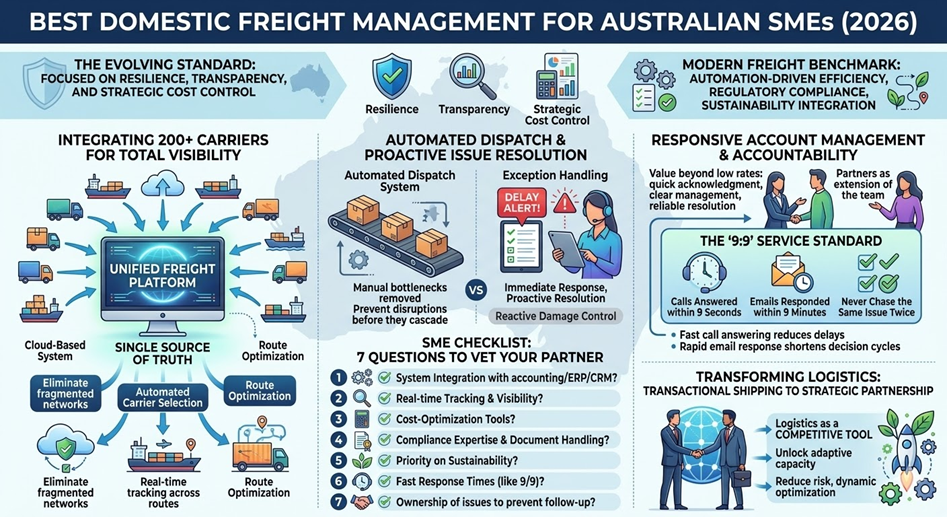
Freight management centralises control through a single partner.

Carriers are selected based on performance, not just cost.

Processes are consistent regardless of destination.


CARRIER SELECTION AND PERFORMANCE

Carriers are assessed on:

– Reliability

– Transit consistency

– Regional coverage

– Damage and claims history

This ensures freight is matched to the right carrier.


DOMESTIC FREIGHT ACROSS STATES

Freight management enables:

– National freight coordination

– Consistent service standards

– Reduced internal complexity


VISIBILITY AND TRACKING

One of the biggest challenges in Australian freight is fragmented tracking.

Freight management consolidates tracking and reporting into a single view.


EXCEPTION MANAGEMENT

Issues are inevitable.

Freight management focuses on early identification and proactive resolution.


COST CONTROL AND REPORTING

Freight data is consolidated to provide:

– Spend visibility

– Lane analysis

– Performance trends


WHY FREIGHT MANAGEMENT IS GROWING

Australian businesses increasingly adopt freight management due to:

– Rising complexity

– Higher customer expectations

– Need for visibility and accountability


FINAL THOUGHT

Freight management allows Australian businesses to coordinate complexity and operate nationally with confidence.

 

Share This Post

Facebook
LinkedIn

More News

For thought-provoking insights and the latest company news.

HOW FREIGHT MANAGEMENT WORKS IN AUSTRALIA

The modern business landscape is characterised by a relentless pace, evolving consumer expectations, and a constant battle for competitive advantage. For Small and Medium-sized Enterprises (SMEs), navigating these complexities can be particularly challenging, especially when it comes to the final leg of delivery. Last-mile logistics, the critical but often costly process of getting products from a distribution hub to the end customer, has become a significant pain point. Escalating surcharges, driven by a confluence of factors, are increasingly squeezing SME profit margins, threatening their ability to compete. However, a strategic paradigm shift towards “elastic logistics” offers SMEs a powerful, often overlooked, weapon to combat these rising costs and thrive in a dynamic market. This article explores how adopting an elastic approach to logistics can transform delivery challenges into opportunities, providing SMEs with the agility and resilience needed to succeed.

Read Article  

Building Resilience: Why Hardware Suppliers Need Managed Freight Solutions

Hardware supply chains are defined by three variables: range, weight, and urgency. From fast-moving consumables to bulky, high-density industrial items, hardware suppliers must navigate a diverse product mix across metro, regional, and remote locations.

In an industry where a late delivery can stall a construction site or leave a retail shelf empty, logistics is the heartbeat of the business. Clique Logistics partners with hardware suppliers to turn fragmented shipping into a streamlined, consistent distribution network.

Read Article  

WHAT IS FREIGHT MANAGEMENT (AND HOW IS IT DIFFERENT TO A FREIGHT BROKER)?

The modern business landscape is characterised by a relentless pace, evolving consumer expectations, and a constant battle for competitive advantage. For Small and Medium-sized Enterprises (SMEs), navigating these complexities can be particularly challenging, especially when it comes to the final leg of delivery. Last-mile logistics, the critical but often costly process of getting products from a distribution hub to the end customer, has become a significant pain point. Escalating surcharges, driven by a confluence of factors, are increasingly squeezing SME profit margins, threatening their ability to compete. However, a strategic paradigm shift towards “elastic logistics” offers SMEs a powerful, often overlooked, weapon to combat these rising costs and thrive in a dynamic market. This article explores how adopting an elastic approach to logistics can transform delivery challenges into opportunities, providing SMEs with the agility and resilience needed to succeed.

Read Article  
Scroll to Top

Error

The tracking number entered did not return any valid consignment. Please try again.

Freight Audit Guide

This field is for validation purposes and should be left unchanged.

contact us

This field is for validation purposes and should be left unchanged.
This field is hidden when viewing the form
Here is a radio button:
This field is hidden when viewing the form
Here is a checkbox: