The Australian logistics landscape is a complex, expansive, and increasingly vital sector that underpins everything from retail supply chains to critical infrastructure. As Australia’s economy grows, fuelled significantly by e-commerce and a demand for efficient delivery, businesses face escalating pressures. The nation’s vast geographic scale, diverse terrain, and dispersed population pose unique logistical challenges that few other markets in the world can replicate.
Against this backdrop, many businesses rely on traditional support structures, often centred around high-volume call centres, to manage their logistics operations. However, in a market valued at $130.4 billion in 2024 and projected to reach $196.2 billion by 2030, this “ticket-based” approach is often inadequate. It leads to missed cost-saving opportunities, fragmented communication, and stifled business growth. This article explores why moving beyond generic call centre support to embrace dedicated account management is the strategic imperative for unlocking significant savings and enhancing efficiency in Australian logistics.
Introduction: The Australian Logistics Landscape and the Call Centre Conundrum
Australia’s economic vitality is intrinsically linked to its sophisticated logistics network. The industry facilitates the movement of goods essential to both domestic consumption and international trade—a sector that accounts for over 20% of the national GDP. This dynamic environment, however, is not without its complexities. The “tyranny of distance” is a literal financial burden for Australian firms; the vast distances between major population centres, the ruggedness of the interior, and a constantly evolving regulatory framework create a challenging operational theatre.
E-commerce continues its relentless expansion, placing unprecedented demands on fulfilment and delivery systems. Consumers no longer view fast, accurate shipping as a perk—they view it as a baseline requirement. Many businesses attempt to navigate this intricate network using conventional customer support models. While functional for basic queries like “where is my parcel?”, this model falls short when confronted with the deep-seated challenges and strategic needs of modern Australian logistics.
The reliance on a generic, reactive support system obscures the pathways to significant cost savings. When your logistics support is treated as a commodity, your supply chain becomes a cost centre rather than a competitive advantage.
Navigating Complexity: Unique Challenges of Australian Logistics
To understand why a call centre is insufficient, one must first appreciate the sheer scale of the Australian logistical undertaking.
The Geography of Cost
The geographic spread between major cities—such as the 3,300-kilometre trek between Perth and Sydney—requires sophisticated transportation planning that transcends simple courier bookings. Unlike the compact borders of Europe or the high-density hubs of East Asia, Australia requires a multi-modal approach (road, rail, and sea) to remain cost-effective.
Infrastructure and Regulatory Hurdles
The Australian freight network moves an enormous volume: approximately 249 billion tonne-kilometres by road and 448 billion tonne-kilometres by rail in the last fiscal year. Navigating this requires an understanding of:
- Varying infrastructure quality: From high-tech metropolitan toll roads to unsealed regional tracks.
- State-specific regulations: Each state and territory has nuances in heavy vehicle regulations and safety standards.
- Environmental Volatility: Australia’s climate—from floods in the north to bushfires in the south—can disrupt supply chains overnight.
A call centre agent in a distant city or overseas hub lacks the contextual awareness to navigate these “boots on the ground” realities.
The Pitfalls of Generic, Reactive Support
Traditional call centres are designed for High-Volume, Low-Complexity (HVLC) resolution. Their primary KPI is often “Average Handle Time” (AHT)—essentially, how quickly they can get you off the phone. In complex logistics, this is the opposite of what a business needs.
The Silo Effect
Staff in a call centre environment often lack deep, specialised knowledge of a specific client’s entire supply chain. They see a single tracking number, not a three-year growth strategy. This leads to fragmented communication, where the business must repeat its history, pain points, and requirements to a new agent with every call.
The $5 Billion Leakage
Inefficiencies in transport and freight alone lead to over $5 billion in annual economic losses in Australia. This is largely due to:
- Idle time at loading docks.
- Duplicated tasks in data entry.
- Poor visibility leading to “emergency” shipping costs.
- Suboptimal routing that ignores regional carrier strengths.
A call centre’s transactional nature means it focuses on fixing the symptom (a lost box) rather than the disease (a flawed distribution model).
Introducing the Strategic Partner: Dedicated Account Management
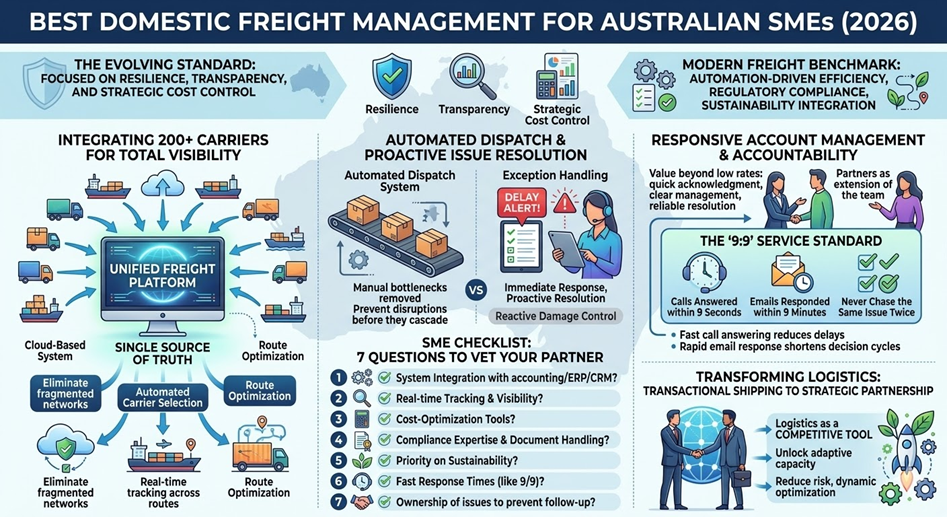
In contrast to the limitations of call centres, dedicated account management offers a paradigm shift. This model centres on assigning a specific individual or team who develops a profound understanding of a client’s unique business objectives.
Beyond the Ticket
A dedicated partner acts as an extension of your own team. They are not just solving a problem; they are proactively seeking ways to prevent it. They move beyond reactive problem-solving to embrace proactive strategy development. This involves:
- Contextual Awareness: Knowing that a specific warehouse has a narrow loading bay or that a certain customer requires “white glove” delivery.
- Holistic Oversight: Viewing the supply chain as an interconnected loop rather than a series of isolated events.
- Strategic Alignment: Ensuring logistics decisions support the business’s broader financial goals (e.g., reducing “Cost to Serve”).
The Limitations of Call Centres in Modern Logistics
The era of transactional customer support is increasingly misaligned with the sophisticated demands of the 2020s.
The Impersonal Nature of Transactional Interactions
When a customer faces a shipping delay, they don’t want a scripted apology. They want a solution that considers their specific inventory management challenges. Call centres treat interactions as standalone events, meaning recurring issues go unidentified. Systemic problems remain unaddressed because the “data” is spread across a thousand different tickets handled by a hundred different agents.
Missed Opportunities for Cost Savings
A call centre agent cannot proactively identify that you could save 15% on freight by consolidating shipments into a specific hub on Tuesdays. They lack the authority and the “big picture” data to suggest inventory management strategies that prevent costly stockouts or overstocking.
“Efficiency in logistics isn’t about working faster; it’s about working smarter through data-driven partnerships.”
Unlocking Tangible Logistics Savings Through Dedicated Expertise
The strategic advantage of dedicated account management lies in its direct impact on the bottom line.
1. Optimising Transportation and Freight Costs
A dedicated account manager possesses the insight to analyse shipping patterns and carrier performance. They can:
- Negotiate better rates: By leveraging the provider’s total volume across their entire client base.
- Consolidate Shipments: Identifying opportunities for “backhauling” (minimising empty miles).
- Select Local Specialists: Using regional carriers for the “last mile” where they are more efficient than national giants.
2. Streamlining Inventory and Warehouse Management
Effective management prevents the two greatest killers of profitability: stockouts and obsolescence. Dedicated managers use data to:
- Implement AI-driven forecasting: Which can reduce stockouts by up to 30%.
- Optimise Space: Ensuring warehouse operations use every cubic metre effectively.
- Reduce Holding Costs: Lowering the amount of capital tied up in slow-moving stock by 10-15%.
3. Enhancing Operational Efficiency
By fostering seamless integration between the client’s systems and the logistics provider’s technology stack—such as Warehouse Management Systems (WMS) and Transport Management Systems (TMS)—they create a unified view. This reduces manual errors and improves lead times, contributing to a more robust supply chain.
Navigating Australian-Specific Logistics Challenges with Confidence
Australia’s unique landscape demands more than just a tracking portal. It demands local intelligence.
Dedicated account managers understand the regional nuances of distribution. For instance:
- Western Australia: Dealing with the specific rail-lead times and the impact of the “Indian Pacific” route disruptions.
- North Queensland: Preparing for cyclone season and the resulting road closures.
- Metropolitan Sydney/Melbourne: Navigating peak-hour delivery windows and restrictive “No-Go” zones for heavy vehicles.
This tailored approach ensures that logistics strategies are not just effective on paper but compliant and optimised for the specific Australian context, preventing costly missteps and delays.
Beyond Cost: Strategic Advantages of a Dedicated Partner
While tangible cost savings are the primary driver, the strategic advantages extend far beyond the balance sheet.
Elevated Customer Experience and Loyalty
Logistics is marketing. The moment a customer receives their package is the most physical interaction they have with your brand. A dedicated partner ensures this touchpoint is perfect. Proactive communication—telling a customer there’s a delay before they notice it—builds a level of trust that a call centre can never replicate.
Scalability and Business Growth
As your business expands from 100 orders a month to 10,000, your logistics needs don’t just grow—they change. A call centre model often breaks under the pressure of scaling. Dedicated account management provides the flexibility and strategic foresight to scale operations seamlessly. They help you forecast warehousing needs and fulfilment capacities before you hit a bottleneck.
Continuous Improvement and Future-Proofing
The logistics industry is undergoing a technological revolution. From industrial robotics to logistics automation, the landscape in 2030 will look vastly different. A dedicated account manager acts as your innovation consultant, helping you integrate these advancements strategically so your business remains at the forefront of efficiency.
Choosing the Right Dedicated Logistics Partner
Selecting a partner is one of the most significant decisions an Australian business can make. It requires moving past the “cheapest rate per pallet” mindset.
Key Qualities to Look For:
- Demonstrable Local Expertise: Do they actually understand the Perth-to-Brisbane corridor?
- Technological Maturity: Can their TMS/WMS integrate with your existing ERP or e-commerce platform?
- A Proactive Mindset: Do they come to you with ideas, or do they only speak when you call them?
- Scalability: Do they have the footprint to grow with you across every state?
Questions to Ask Potential Partners:
- “Can you show us an example of how you proactively identified a cost-saving for a similar client?”
- “What data will my dedicated account manager provide me with every month?”
- “How do you handle the ‘Chain of Responsibility’ (CoR) safety requirements in Australia?”
- “How does your team manage logistics disruptions during the Australian summer bushfire/flood season?”
Conclusion: Elevate Your Australian Logistics with Strategic Account Management
The Australian logistics landscape presents both immense opportunities and significant challenges. For businesses aiming to thrive in an era of e-commerce dominance and rising operational costs, the status quo is a recipe for stagnation.
Moving beyond the limitations of traditional, reactive call centre support to embrace dedicated account management is no longer a luxury—it is a strategic imperative. This shift unlocks significant cost savings through optimised transportation, inventory, and warehouse operations. More importantly, it provides the peace of mind that comes from knowing your supply chain is being managed by someone who understands your business as well as you do.
Recap: The Power of Proactive Partnership
Dedicated account management offers a strategic partnership that contrasts sharply with the impersonal, transactional nature of generic support. The benefits—ranging from immediate cost reductions to long-term scalability and customer loyalty—ensure your business is robust, efficient, and future-ready.
Take the Next Step Towards Optimised Australian Logistics. The journey to unlocking greater savings begins with recognising the limitations of your current support model. Embrace a partnership that offers more than just a service—choose a collaborator invested in your success.